Tuesday, December 1, 2015

Dynjandi Waterfall (Westfjords, Iceland)


After our stay in Flókalundur, we drove up the west coast to Ísafjörður. On our way, we passed by this roadside sculpture.  I don't know what it is meant to represent, but I found it intriguing.


The clouds came down to touch the mountains as we drove north.


We drove through the clouds high on a mountain road . . . it looks like the world ends just beyond that bit of road.


Our next stop was the Dynjandi waterfall, which was my favorite of the waterfalls we saw in Iceland. It was beautiful, with lots of lovely falls and a nice hike up to the top.


We were able to get quite close to the falls. It was refreshing to be able to interact with its natural beauty without the various barriers I'm used to in the natural tourist attractions in the United States.


We could get *really* close to the falls -- if you look carefully, you can see Q in the lower right corner, right next to the water.


There were also a number of interesting plants along the hike up to the top of the waterfall.  These little puffballs were all over Iceland, creating drifts of white in the fields.  Apparently, this is Eriophorum scheuchzeri (Scheuchzer's cottongrass).


Look at all the different colors of lichen and moss on this rock!


The Icelandic plants are fragile, and tourists trampling on them can damage the ecosystem. These signs and rope barriers protected the native flora from those of us hiking up the Dynjandi waterfall.


We made it to the top! Q noted that the sound of the waterfall was not constant, but varied and included a number of different sounds, depending on the flow of the water.


Gorgeously vibrant green moss lushly textured the rocks next to the main falls.


There was an intriguing vein of red rock at the top of the falls. Ah, if only a geologist had been handy to explain it to us!


After hiking back down, we walked out to the shore and watched the Arctic terns fly over the fjord and perch on the rocks.


At some point during the hike down from the top of the Dynjandi waterfall, Q managed to zip his hoodie and rain slicker together. Upon discovering it, he said that he had inadvertently invented the world's first spiral garment.  "Now if I could zip the right side of the rain slicker to the left side of the hoodie, I'd be a Moebius strip!"

Next up: Ísafjörður

Monday, November 30, 2015

Latrabjarg Bird Cliffs (Westfjords, Iceland)


After our overnight stay in Borgarnes, we drove north to the Westfjords. We stopped at a lookout point on our way through the Breiðafjörður region that included this signage.  It tells the story of the Laxdæla saga, a love triangle that ends in tragedy.  It was a new story for me, as I wasn't familiar with the Icelandic sagas.  I couldn't figure out what this sign marked, though -- were we looking at the valley where Bolli killed Kjartan?  I do quite like the idea of celebrating famous stories with roadside markers, though.  It seems consistent with the emphasis on books in Icelandic culture.


The Westfjords are less populated and less often visited by tourists than other regions in Iceland.  It was quite a bit colder there, too, as we got closer to the Arctic circle.  The roads are often unpaved as they wind up and down around the mountains and fjords.  It takes much longer to drive than estimated by Google maps.

But even so, we took time for some side jaunts on the way to our hotel.  We drove out to Reykhólar, a tiny town with a factory and a museum.  We didn't tour the museum, but took the opportunity to sit in the cafe for coffee and a piece of decadent chocolate cake served with frozen blueberries and cream.  Later on in our drive, we passed by this turf house. I had heard about the Icelandic turf homes and wanted a closer look, so we pulled off the road so that I could stand amidst the sheep droppings and take a picture.

Eventually, we made it to our hotel in Flókalundur in late afternoon.  We dropped off our luggage and headed out again to drive to the Latrabjarg Bird Cliffs.  I was committed to getting out there so that I could get a chance to see a puffin.  Years ago, we visited Scotland (another country with puffin colonies), but we didn't go to the Northern Highlands where we could have seen the puffins.  Ever since then, I had a long-standing (jesting) pout that we "went all the way to Scotland, and I didn't get to see a puffin."  Q was going to make sure that I got to see puffins this time!


It was another long drive to Latrabjarg.  The speed limits in Iceland seem slow to an American driver, but with good reason. Even on easy roads, one is likely to encounter unpredictable sheep crossings. And many of the roads, like this one, are unpaved and winding, with blind hills and sheer drops off to one side (and few guard rails!). The sharp switchbacks along mountainous roads require slow, careful driving. So we didn't begrudge the speed limits, in most cases. This fellow was reminding us as we went through a small group of homes that we should slow down to 30kph. From a distance, the figure was very realistic -- a creative way to get the driver's attention and remind them about the speed limit.


When we finally got to the Latrabjarg bird cliffs, it was evening (although given the long daylight hours, it wouldn't get dark for some time yet).  The guide book recommended visiting the bird cliffs in the evening, as the birds would be returning to their nests at that time.  I had heard that puffins were shy -- hard to catch a glimpse of, and even more difficult to photograph.  So I feared that we would need to look around for a long time to see even a hint of a puffin.  But we got out of the car, walked from the parking lot toward the cliff edge . . . and immediately, we saw a couple of puffins.  We were even able to move toward them and take photos without having them fly away or pop down into their holes.
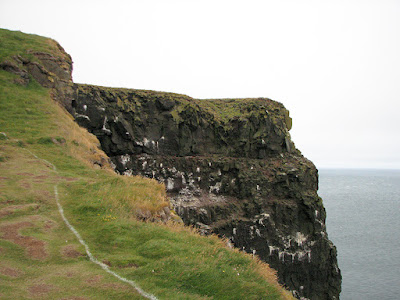

It was quite windy and cold the evening we were there. As you can see, there was only a painted line to indicate the minimum safe distance from the cliff edge -- there were no guard rails or fences, so we could see the birds clearly and even get close to them.  But given the signage about the danger of falling off the cliff and the very strong wind, we stayed well back from the edge.


The cliffs were full of all kinds of different birds.  I think these roosting birds are guillemot.


I'm not sure what species of bird these are -- maybe gulls or kittiwakes?


The Latrabjarg cliffs are 440 meters high and 14 kilometers long. We walked up to the top, but didn't walk the whole length of the cliff (it was just too windy and cold!).  At one point, the wind shifted and we got a strong scent of rotting fish, so I guess the cold might have been a boon in some ways.


And everywhere along the cliffs, we saw puffins.


My friend Karen captioned this one, "I can't see my toes!", which makes me giggle.


Puffins are just adorable!  I took a lot of photos of puffins at the Latrabjarg bird cliffs. I'm seriously puffin-obsessed.


Did I mention that there were puffins at the Latrabjarg bird cliffs? 


Puffins nest in little holes on the tops of the cliffs, and since they aren't hunted here, they are not shy of people. I think the person in the green jacket is putting out seeds, and that's why so many puffins are gathered there.


A group of puffins has many collective nouns, including a "burrow", "circus", "colony", "improbability", and "puffinry" of puffins. via
I love the idea of an improbability of puffins!  Except that I guess they aren't so improbable, since I finally got to see them.  

Waterfall by the side of the road
on the way back from Latrabjarg

There is water everywhere in Iceland. Iceland is surrounded by the ocean. Parts of the country are covered by glaciers. Boiling-hot, sulphuric water spurts up in geysirs or puffs out clouds of steam from fissures in the rocks. And everywhere, there are waterfalls. Large and powerful, small and quiet, water streams down from the mountains. This waterfall was so beautiful that we actually turned around on the highway and drove back to take photos of it. It's not a famous waterfall or a tourist attraction -- just part of Iceland's natural beauty.


I loved the vibrant greens of the mosses growing around the waterfall.  Our next day's journey would take us to a larger and even more beautiful waterfall.  

Sunday, November 29, 2015

Horses and dogs and sheep, oh my! (West Iceland)


After many hours of driving from Landmannalaugar, we finally arrived at our lodging in Borgarnes (past their check-in time, but thankfully, they were willing to stay open for us).  As we unloaded our luggage, we were greeted by a Very Friendly Dog.  While we were never introduced, the dog clearly loved people and wanted to play.  At one point, Q said "I wish I had a stick to throw for you."  The Very Friendly Dog perked up its ears, as if to say "Stick?  I have a stick!  Wait -- I'll go get my stick!"


The Very Friendly Dog then proceeded to teach Q how to play Stick.  They had a great time playing in the meadow.


Who can resist that sweet face?  The Very Friendly Dog was just one of many creatures we encountered during our travels in Iceland.


As we left the following morning, we spotted Icelandic horses in the field next to the inn.  We saw lots of horses as we drove through Iceland, particularly in West Iceland.  Horseback riding is an activity enjoyed by Icelanders and tourists (we didn't do any riding, but we enjoyed seeing the horses).

Icelandic horses in West Iceland

Icelandic horses are a unique breed. They are relatively small in stature and are adapted to the harsh climate with a double coat to protect against cold temperatures. They are the descendants of the horses brought to Iceland by the original Scandanavian and Norse settlers.  Horses were the only means of transport for many hundreds of years in Iceland.

Icelandic horses in West Iceland

Icelandic horses have a wide range of coloration. Because livestock cannot be imported into Iceland, the horses are protected from most diseases and parasites. Icelandic horses, if they leave the country, cannot return.

Icelandic horses in West Iceland

Icelandic horses have two additional gaits, beyond those of other horse breeds. In addition to walk, trot, canter, gallop, they are capable of a lateral, ambling gait called a tölt, and a fast, smooth skeið gait (or "flying pace").


The most ubiquitous animal we saw, though, was sheep.  They were scattered across the landscape, so commonplace that we noted their absence more than their presence.  We started taking bets on how long it would be before we saw another one.  We announced their presence by calling out, "Sheeeeep!  SHEEEEEEEP!" to each other.  Some parts of Iceland have more sheep than people (a pattern we noted in the West Highlands of Scotland, as well).  Anywhere that had even the barest hint of greenery seemed to sport sheep.  They slept by the side of the road.  They wandered out into the roadway (another excellent reason to observe the speed limits in Iceland).  Sometimes, they ran at the sound of the car or stared at us as we passed by.


But mostly, they just ignored us and went about their sheep-y business.


I got this tiny felted sheep (made by Steinunni Steinars) at the Borgarnes' farmers market.  Isn't it adorable?  It sits on the kitchen windowsill, along with the wooden sword swallower and pig that were my mother's, so that I can see them every day as I wash dishes.  And whenever I see it, I can call out:

Sheeeeeeep!  SHEEEEEEEEEEP!


Next up:  The Latrabjarg Bird Cliffs in the Westfjords

Saturday, November 28, 2015

Landmannalaugar, Iceland


Landmannalaugar is the starting point for a multi-day hike to Þórsmörk, but we just did a half-day hike from the main campground up to Breinnisteinsalda. It was chilly, overcast, and rainy, but the terrain and the views were truly spectacular.


I'm pretty sure that trolls live here. It reminded me of the stories where we think that these are just rocks, and then they start moving and talking.


You can see part of the campground from here. There aren't many amenities, but there are showers and restrooms, an information center, and sometimes a bus that sells (high-priced) food. And, of course, natural hot springs (hot pots are an Icelandic necessity).


It was the mention of multicolored mountains that drew me to this place. I drank in the sight of richly colored hills, with streaks and smears of each hue running down the sides, set off by the bright white patches of snow.


The hills are swirled with color. . .


and streaked with rainbow stripes of color.


Multi-hued stones are everywhere along the trail. I was so very tempted to take one of these colorful rocks home as a souvenir . . . but I resisted. (I saw another hiker take some rocks, but it just seemed as though it would be prohibited to remove the stones.)


I am dreaming of a rock garden made of ryolite lava stones . . . *sigh*.  


Here we are at the top of Breinnisteinsalda.  It was cloudy and drizzling, so perhaps the view was not as expansive as it would have been on a clear day, but it was still beautiful.  (Though it is hard to get a good selfie in the rain.)


Looking down the trail from Breinnisteinsalda, the valley is full of sulfuric steam emerging from the ground.  I know it's geothermal activity, but it looks like a dragon's lair to me.  Surely Smaug will emerge at any moment to defend his hoard.


As we hiked back from Breinnisteinsalda, my hiking boots fell apart.  The soles had started to split and they finally separated, leaving my feet unprotected as the sole flapped with each step.  Complete shoe failure.  Luckily, I had noticed the split before we started hiking and Q was willing to carry my sneakers in case they were needed.  So Landmannalaugar claimed my hiking boots and I finished up the hike in sneakers.  A small price to pay for being surrounded by such gorgeous scenery.

Even now, I ache a little when I think of the beauty of Landmannalaugar.  I only wish we could have stayed longer.  But we had a long drive to our lodging for that night, so we had to leave.


Next up:  Horses and dogs and sheep, oh my!