Showing posts with label history. Show all posts

Monday, December 7, 2015

Museum of Icelandic Sorcery and Witchcraft (Westfjords, Iceland)

Our last stop in the Westfjords was Holmavik, where we enjoyed a delicious meal of carp and potatoes and then visited the Museum of Icelandic Sorcery and Witchcraft.

In its early history, Iceland almost faced civil war over the split between pagans and Christians.  The issue came to a head in 1000 at the yearly gathering of chiefs (Althingi). The law speaker, Þorgeir Þorkelsson Ljósvetningagoði (himself a pagan), pondered the matter for a day and a night, and came to the decision that Iceland should embrace Christianity, but that pagans could still pursue their religion in secret.

But later, even secret pagan practices became outlawed and during the witch-hunts of 1625-85, twenty-one Icelanders were executed under accusations of witchcraft. Iceland's history of witch trials differed somewhat from those in other countries, in that men were accused more often than women. Most were poor, living in hardscrabble conditions in the Westfjords, and sometimes the accusations were based merely on knowing runes or staves or owning forbidden texts. (One man was accused based on his writings about medicine.) Accusations of witchcraft might be prompted by the presence of illness or misfortune in the village. One woman's illness served to instigate accusations against 6 different men over the course of several years.


The museum included details of the various trials, including a genealogical chart showing the family connections of many of those involved in the cases. There were also descriptions of spells and runes ostensibly used by witches and sorcerers. The spells ranged from acts of destruction (bringing storms to those at sea) to spells bringing prosperity (transforming a human rib into a tilberi who steals milk from other people's sheep and delivers it to the witch's churn). The necropants in the above photo are a prosperity spell. According to the museum, one creates the necropants in the following manner:
"If you want to make your own necropants (literally; nábrók) you have to get permission from a living man to use his skin after he is dead. After he has been buried you must dig up his body and flay the skin of the corpse in one piece from the waist down. As soon as you step into the pants they will stick to your own skin. A coin must be stolen from a poor widow and placed in the scrotum along with the magical sign, nábrókarstafur, written on a piece of paper. Consequently the coin will draw money into the scrotum so it will never be empty, as long as the original coin is not removed. To ensure salvation the owner has to convince someone else to overtake the pants and step into each leg as soon as he gets out of it. The necropants will thus keep the money-gathering nature for generations."

Runes or staves might be written on paper or a scrap of leather, or they could be carved into wood, as with this protective sign.

It was a small but fascinating museum -- the poor lighting made it hard to get good photos, unfortunately, so you'll just have to go visit the museum yourself to see the exhibits. In the meantime, you can find out more about the museum in this video:

There are more videos about the museum here.

Next up: Last looks, landscapes and lichen in West Iceland

Sunday, December 6, 2015

Litlibaer (Westfjords, Iceland)


Just up the road from the seal colony is Litlibaer, a historical 19th century farmstead. Not only is it a charming home with historic photos and tools, but they serve coffee and waffles! Just the restorative lunch we were looking for after a long drive.


Here you can see the traditional turf roof on the farmhouse. It also included both stone and wood construction.


The rooms were quite small, with low ceilings -- very cozy. We ate at the table by the window and enjoyed looking at the photos of family members who had lived at the farmhouse over the years.


A small pantry area next to the stairs included a variety of historic kitchen tools.


Q is enjoying his coffee and waffles.  (Not being a coffee person, I had hot chocolate.)  The waffles were heart-shaped and topped with jam and whipped cream -- quite delicious!


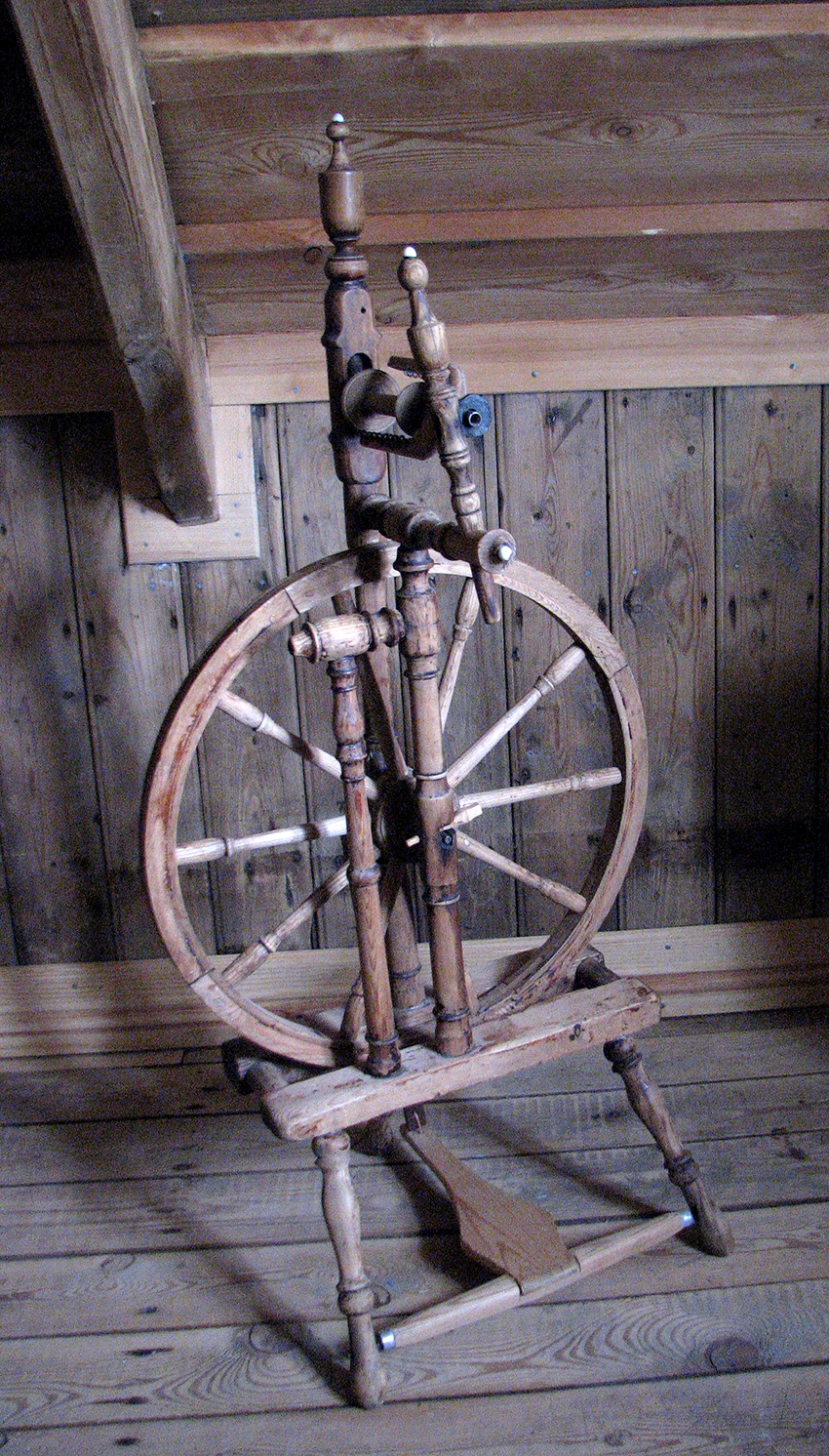
A ladder to the attic revealed two more (small) rooms, each with tools and materials presumably from the 19th century work at the farm. Wool is a major Icelandic product, so spinning would have been a common activity.


More antique tools were displayed under the attic window.


And, of course, I had to take a photo of this beautiful antique sewing machine. It's all set up with thread and everything! I managed to resist the temptation to do some sewing.

Next up: The Museum of Icelandic Sorcery and Witchcraft

Saturday, November 7, 2015

Þingvellir National Park, Iceland

Þingvellir National Park, Iceland

After leaving Reykjavík, we were off to see the Golden Circle, which includes Þingvellir, Geysir, and Gullfoss. We started in Þingvellir National Park, which is located on the boundary between the North American and Eurasian tectonic plates. In most places, these plates can just slide past each other, but here, they break apart, as much as 1mm to 18mm per year, resulting in dramatic fissures and earthquake activity. This photo is from the entrance to the park, just past the visitors center. It is actually a pretty small rock fissure, but somehow I can capture the feeling of the earth separating more on this small scale than in the larger rifts we walked through.

The Almannagjá fault in Þingvellir National Park, Iceland

The path from the visitors center takes us on the Almannagjá fault toward the Lögberg, the Law Rock. This gives you a better sense of how big the rifts can get along the tectonic plates in the Þingvellir plain. It also shows you how popular this site is -- look at all the visitors!


I love these textured rocks -- I don't know what process gives them these striations, though. Is this the result of the lava flows from volcanic activity or the stress of the tectonic plates? (Maybe, as Q said, these were giant fingerprints!)


Another cool textured rock. This trip made me wish I had taken a geology course in college. Or that I just had a geologist along to explain things to me.


We stopped to take a selfie as we walked through Þingvellir.


And there were mysterious paths into the rocks . . . but signs forbade us from straying off the main path, as it damages the fragile plants. (We saw other visitors doing so, though, much to our annoyance.)

Of course, Iceland is full of hidden treasures.  Did you know that in his book, Journey to the Center of the Earth, Jules Verne placed the passage leading to the center of the earth at the mountain Snæfellsjökull in western Iceland?  


Þingvellir is also a key historic site.  Beginning in AD 930, the Icelandic national democratic assembly (Alþingi) was held yearly in Þingvellir. (This remained the national legislative assembly until 1271, at which time governance was surrendered to the Norwegian crown, though Þingvellir continued to be used as a courtroom until 1798.) People traveled from all over Iceland to attend -- here they would pass new laws, make criminal judgments, create marriage contracts, and enjoy the opportunities for trade and entertainment.

This is the view from the Lögberg (Law Rock). Here the Law Speaker would recite from memory the existing laws of Iceland (one third of the laws were recited each year, along with the rules of the parliament). The early Icelanders re-routed the river to provide water to the site of the Alþingi -- unfortunately, this caused problems later on with flooding and made the site almost impassible in some years.


The annual Alþingi acted as a national court, where criminal cases were heard and punishment enacted. Punishments might involve fines, outlawry, flogging, or execution. This is Drekkingarhylur ("the drowning pool"), where, up to the early 18th century, women who were convicted of adultery, incest, or infanticide were drowned. (Men convicted of capital crimes weren't drowned -- they were burned or hanged.)


Q got to clamber on the rocks near Öxarárfoss (a waterfalll flowing from the river Öxará over the Almannagjá rift). The story is that this is where the river was redirected by the Vikings for the Alþingi.


Q gets up close and personal with Öxarárfoss. 

Closeup of Öxarárfoss in Þingvellir National Park, Iceland

The water is flowing by, but I can capture just this one moment with my camera.

One of the reasons I enjoy posting photos and travelogue is to better remember our journey. Without a story, the memories tend to fade away. But when I capture a moment in time and place it into a narrative, I get to keep the memory. (Or, as cognitive science would argue, I construct the memory. Whatever. I still get a memory.)


Next up: Geysir

Sunday, October 11, 2015

More to see in Reykjavik, Iceland

(Just as a heads-up -- this post includes a discussion of phalluses, as well as some pictures of preserved animal phalluses.  And ancient books.  And political art.  There is also mention of food and a spa.)

Saturday, April 4, 2015

We Who Believe in Freedom

This semester I've been sitting in on classes in Photoshop, television production, and video editing.  It's been interesting to be working so much on visual skills, particularly since I am typically so immersed in the world of words.  In my teaching, in my scholarship, and even blogging, I'm very verbally oriented.  To be sure, I have my visual side, as well, in my textile and photography work, but I am generally less well-versed in visual storytelling than in verbal storytelling.  So it's been a terrific opportunity to grow and develop some new skills (although quite a steep learning curve, as well!).

Our most recent video editing project involved creating a music video using still photographs using Adobe Premiere Pro.  I struggled for a while to develop an idea for the project.  I knew that I wanted to do something around the history of social activism movements, but I couldn't identify the right music.  I spent some time researching songs until I rediscovered a song I used to listen to years ago.  At that point, the vision for the video really came together.  Then I spent endless hours looking for suitable photos online (they had to be topically relevant, visually compelling, and sized large enough).  Thank goodness for the Library of Congress online database!  That was a rich trove of terrific images.  Of course, then I had to make choices about which photos to use (I gathered more than I needed) and in what order, as well as creating movement through the piece.  My first draft was good, but Q noted that the movement across photos was less continuous and smooth.  So I tweaked it to create more consistency in the movement across photos, which I think improved the flow of the video.  I spent another day looking for the source information for the photos (trying to find the name of the photographer, etc.), so I could give appropriate credit.  (Have you noticed how often websites use a photo without any information on its source?)

So it took about two weeks of work, but I learned a lot from the project, both in terms of working within Adobe Premiere Pro and visual storytelling more broadly.  I'm also fairly pleased with the final product.  Enjoy!


Thursday, January 1, 2015

St. Vitus Cathedral and Prague Castle (Prague, Czech Republic)


St. Vitus Cathedral

Our walk around Hradčany included seeing Bílek Villa (an art nouveau villa designed by Czech sculptor and artist, František Bílek; we just saw the outside, as it was closing when we got there), the Pisek Gate (a baroque gateway that was part of the new fortifications built in the 18th century -- alas, it was under construction) and two cubist houses designed by Josef Gočár. By that time, it was getting dark, so we walked over to Prague Castle to see St. Vitus Cathedral by night.

The building of St. Vitus Cathedral took over 600 years (beginning in 1344 and not completed until 1929). It is an amazing Gothic cathedral -- Q was particularly struck by the elaborate flying buttresses (not visible in this photo). The cathedral itself was closed at night, so we decided to come back the next day to see the interior.


 The stairs up to Prague Castle

Wednesday, December 31, 2014

Malá Strana and Hradčany (Prague, Czech Republic)


John Lennon Wall

After our lengthy perusal of the Musaion, we walked through Malá Strana (the Little Quarter or Lesser Town). We saw more beautiful buildings, including the Czech Museum of Music, among others, before we found our way to the John Lennon Wall.

After John Lennon was murdered in 1980, an image of him was painted on this wall (across from the French embassy), along with political graffiti and Beatles lyrics. The secret police kept whitewashing the wall, but the graffiti was always replenished. (Not only was John Lennon a pacifist hero for many young people, but most Western pop music was banned by the communists -- some Czech musicians were arrested for playing Western pop music.)

After the Velvet Revolution in 1989, much of the original graffiti was lost to weathering and additional graffiti, but now visiting tourists have contributed their own political messages and other graffiti.

Yes, the guitarist was playing a Beatles tune. And yes, we gave him some coin. :-)


Monday, November 17, 2014

Czech Holiday Costumes & Customs (Musaion, Prague)

In addition to showing folk art, costumes and tools, the Musaion (Ethnographic Museum) also had exhibits related to the major religious holidays. Many of the costumes and practices were derived from pre-Christian traditions, including themes of nature and respect for ancestors.  The signage at the museum didn't include specific details about the particular costumes, so I did a bit of internet research and turned up a number of unusual Czech folk traditions. 


Sunday, November 16, 2014

Petřín Hill and the Musaion (Prague, Czech Republic)


Lego Museum

On our fifth day in Prague, we walked to Petřín Hill, a large public park. On our way, we looked in at the Lego Museum. While we didn't actually go in to see the museum exhibits, we ogled the Lego kits in the shop and admired this mural, made entirely of Legos. 

View from the Legion Bridge (Most Legií) over the Vlatava River

On our way to Petřín Hill, we crossed over the river via the Legion Bridge, which was virtually empty of pedestrians (compared to the crush of the Charles Bridge). This photo is looking toward the Charles Bridge.  You can see beautiful pictures of the Legion Bridge here.

Friday, November 14, 2014

Wenceslas Square (Prague, Czech Republic)

After spending the morning at the Mucha museum, we walked around Wenceslas Square in New Town (Nové Město). Wenceslas Square was the site of the 1989 Velvet Revolution demonstrations and the announcement of the fall of communism in what was then Czechoslovakia. The square is now a testament to capitalism, with loads of shopping and eateries, but also has some interesting architecture and public art.


Grand Hotel Evropa

Monday, November 10, 2014

The Sex Machines Museum (Prague, Czech Republic)

We often enjoy quirky, off-beat museums, so we made time to visit two museums listed as part of "Eccentric Prague" in one of our guide books: The Museum of Torture Instruments and the Sex Machine Museum. I didn't take pictures at the torture museum -- not only was the content disturbing, but I wasn't sure about the historical accuracy of the signage or the provenance of the actual implements being shown.

But I did take photos at the Sex Machines Museum -- after all, being a sex educator, this is work related for me. (Does this make my whole trip a tax write-off?) This is the third sex-related museum we've been to -- we've seen the Museum of Sex in NYC and the Erotic Museum of Barcelona. The Sex Machine Museum in Prague was good, although I would have liked more detailed signage to provide context for the items shown. The museum exhibits included a variety of sex aids, including some elaborate mechanical sexual furniture, as well as anti-masturbation machines and clothing, chastity belts, and BDSM equipment and accessories.


[Note:  If you are offended by frank discussions or depictions of sexuality, you may not wish to read further.]

Saturday, November 8, 2014

Municipal House and the Jewish Quarter (Prague, Czech Republic)


Municipal House (Obecní dům)

Just a few blocks from our hotel is the grand Municipal House, one of the finest examples of Prague Art Nouveau. It was built on the site of the former royal palace in the early 20th century and a number of artists contributed to its design and decoration, including Alfons Mucha. It currently houses civic functions, a ballroom and the Smetana concert hall.

We were only able to look at the public areas of the building, as we couldn't make it to one of the daily tours, so we didn't see the paintings by Mucha in Mayor Hall. But we did spend a solid morning at the Mucha museum a couple of blocks away, poring over his posters, paintings, and sketches, as well as watching a film about his life. He is often best remembered for the work he did in Paris, so I did not know how much he worked for the creation of an independent state and recognition of the history and culture of those in Czechoslovakia. He was pleased to provide his work to a number of buildings in Prague and he spent years finishing his Slav Epic. He was among the first to be arrested by the Nazis after they invaded and it broke his health, as he died shortly after being released. 


Municipal House (Obecní dům)

There was beautiful metal work in the outdoor railings as well as around the elevator in the lobby. I'm sparing you the photos of the elevator grille I took. Seriously, though, would one ever get tired of this beauty?

Friday, November 7, 2014

Old Town (Prague, Czech Republic)


Lokál (Prague, Czech Republic)

Our first night in Prague, we had dinner at
Lokál, a restaurant/beer hall which features Czech cuisine. It was very loud and a bit smoky (even in the non-smoking section), but the food was tasty. The table next to ours was celebrating some special occasion, perhaps a birthday, as they brought a cake as well as ordering lots of beer. Sadly, they didn't offer us any cake.

I liked the designs scratched into the wood paneling (lit from behind, they glowed). We decided this might count as an example of sgraffito (a Renaissance technique of creating designs by scratching into a surface to reveal a different color or tone underneath).  Both Q and I remember doing crayon sgraffito as children; I put down colored crayon markings and then covered the entire page with black crayon (a tedious process that kept me occupied
for some time -- looking back, I can see why my mother encouraged this activity).  Then I used a pin to scratch through the black crayon, revealing the colored crayon underneath.  Sgraffito!  (I wonder, would reverse appliqué be a kind of textile sgraffito?)

Church of Our Lady Before Týn

After our dinner, we wandered around the Old Town (Staré město) area, walking by In Utero, a large sculpture of a pregnant woman, one of the many David Černý sculptures in and around Prague.

We found our way to the Old Town Square (Staroměstské náměstí), which has been Prague's main public square since the 10th century. We walked through the square virtually every day we were in Prague, and it was always full of people. We saw a variety of musicians as well as some dancer/contortionists, in and amongst the throngs of tourists. That first night we were treated to a women's chorus (which brought back fond memories of when I sang with the Anna Crusis Women's Choir), although I have no idea what the women were singing, as it was (presumably) in Czech.

The
Church of Our Lady Before Týn, with its Gothic spires, was not only dramatic at night and beautiful inside by day (no photos allowed, alas), but it also provided a terrific landmark to orient us as we walked around Old Town. The church was built in the 15th century. The interior is Baroque in style and contains the tomb of Tycho Brache, the famous Danish astronomer who died of a burst bladder, being too polite to leave the royal table to relieve himself. Let that be a lesson to you.

Thursday, November 6, 2014

The Art Deco Imperial Hotel (Prague, Czech Republic)

The foyer in the Art Deco Imperial Hotel (Photo by Q)

Our hotel in Prague was absolutely beautiful. The Art Deco Imperial Hotel was built in 1914, and combines the architectural styles of Art Deco, cubism and Art Nouveau. The hotel interior is full of gorgeous tile work, such as this bas-relief in the foyer that reflects Egyptian motifs. The building is listed as a Czech National Monument. 

Saturday, November 1, 2014

Wawel Hill & the Jewish Quarter in Kazimierz (Kraków, Poland)


Wawel Cathedral (Kraków, Poland)

We had another beautiful day to explore Wawel Hill, the site of Wawel Castle and Wawel Cathedral. This Gothic cathedral held coronations, royal funerals and entombments for centuries.

The tower on the left is a clock tower, topped by a Baroque spire (18th century) and statues of saints Wacław, Adalbert, Stanislaw, & Kazimierz. The tower on the right is a bell tower.

But behind it (not visible from this angle) is Zygmunt/Sigismund Tower which holds the Zygmunt/Sigismund Bell, the largest historic bell in Poland. It is 2m high, 2.5m in diameter and weighs 11 tons (the clapper alone weighs 350kg). It takes eight strong people to ring the bell. We walked up the twisty and narrow stairs to see it and it is indeed huge and heavy-looking. You can see the bell and hear how it sounds here.

Photos were prohibited inside the Cathedral, so I can't show you the gorgeous stained-glass windows. But you can see some nice photos of the interior of the cathedral here.  


Friday, October 31, 2014

Auschwitz-Birkenau (Oświęcim, Poland)

As we were planning our trip to Poland, we knew that we needed to include some historical sites related to WWII and the Holocaust, as these are significant aspects of Polish history.  Kraków itself escaped much of the bombing that flattened cities like Warsaw, allowing its medieval architecture to remain intact (as we saw in Old Town).  But it was just outside of Kraków, in Auschwitz-Birkenau, that the Nazis first experimented with the gas chambers that would become the "final solution."  The camps are now a memorial and museum; we put this on our must-see list of sights.  (We had hoped to see the Schindler Factory museum, as well, but didn't manage to find time to get there.)  We took a bus from Kraków to Oświęcim, a small town where former Polish army barracks became Auschwitz and where the Nazis built the Birkenau extermination camp, using the forced labor of those brought to the camps.


These birds greeted us as we arrived at Oświęcim to see the Auschwitz-Birkenau Memorial & Museum. I couldn't identify the species of bird, although they seemed vaguely pigeon-like. We had a quick bite to eat on the benches outside the museum, waving away bees, before we embarked on the four hour tour of the camps.

Thursday, October 30, 2014

Wieliczka Salt Mine (Poland)


Sculpture in the Chapel of St. Kinga in the Wieliczka Salt Mine

After exploring Old Town in Kraków, we took a bus trip out to see the Wieliczka Salt Mine.  The Wieliczka Salt Mine has been in operation from the 13th century (although at this point there is no salt being mined; miners work to maintain the structures of the mine). Legend has it that the salt in the mine was the dowry of Princess Kinga, who became the patron saint of salt miners. The mine is enormous -- 300 km over 9 levels (but the tours only include the upper three levels). The tour includes displays of how salt was mined as well as the amazing sculptures created from salt by the miners.

The mine contains a number of chapels, but the St. Kinga chapel is the most impressive. It is a huge chamber, full of detailed sculptures and bas-reliefs made from rock salt (including a replica of The Last Supper and a statue of Pope John Paul II). The sculptures in this chapel were made over the course of 30 years by just a few of the miners in their spare time. The artistry is exquisite. You can see more of the sculptures here.  

Wednesday, October 29, 2014

Old Town (Kraków, Poland)

Singing group in the Maly Rynek in Kraków

Generally, my schedule revolves around the academic year, so if we take a vacation, we do so during the summer.  But this year, I'm on sabbatical (my first sabbatical ever), so we were able to take a trip in the fall.  We spent two weeks visiting Kraków in Poland and Prague in the Czech Republic.  (Note that this travelogue will not be precisely sequential, but rather thematic or by area -- we visited some areas more than once, so I'll sometimes use photos from different days of our trip in the same post.  You can click on the photos to enlarge them, if desired.)

Our visit to
Kraków coincided with the Kraków Film and Music Festival, so there were various performances, films, and booths set up in the Maly Rynek (small town square) and the Rynek Główny (main town square) in Old Town. The town squares had a festive atmosphere, even at night, which was quite delightful -- lots of vendors and food stalls, as well as performers.  The photo above shows one of the performing groups in the Maly Rynek, presumably singing traditional Polish music.

Saturday, June 1, 2013

Birthday giveaway #1

Tommy bowed and Annika curtsied and then they handed Pippi the green package and said, "May we congratulate you and wish you a happy birthday?"  Pippi thanked them and eagerly tore the package open.  And there was a music box!  Pippi was wild with delight.  She patted Tommy and she patted Annika and she patted the music box and she patted the wrapping paper.  She wound up the music box, and with much plinking and plonking out came a melody that was probably supposed to be "Ack, du käre Augustin."

Pippi wound and wound and seemed to forget everything else.  But suddenly she remembered something.  "Oh, my goodness, you must have your birthday presents too!" she said.

"But it isn't our birthday," said Tommy and Annika.

Pippi stared at them in amazement.  "No, but it's my birthday, isn't it?  And so I can give birthday presents, too, can't I?  Or does it say in your schoolbooks that such a thing can't be done?  Is it something to do with that old pluttifikation that makes it impossible?"

"Oh, of course it's possible," said Tommy.  "It just isn't customary.  But for my part, I'd be very glad to have a present."

"Me too," said Annika.

From Pippi Longstocking by Astrid Lindgren (translated from the Swedish by Florence Lamborn), 1950.
As I continue my travels along The Great Material Continuum, I'm taking a cue from Pippi Longstocking with a series of giveaways to celebrate my birthday.  Actually, my birthday was some days ago, but Q and I have a tradition of a "Birthday Week" -- and I'm still within my birthday week.  Heck, why can't I have a Birthday Month?   (After all, Lyric Kinard has been having blog giveaways throughout her birthday month.) 

I'm going to give away items that reflect the diversity of my interests.  After all, I am a versatile blogger and need to recognize all aspects of my multifaceted life, right?  Psychology, sexuality, feminism, art, sewing, beading, gardening, dance -- there will be something for everyone.

Friday, April 17, 2009

Weird (musical?) instrument

I heard on Wait Wait Don't Tell Me about this early pre-cursor to the Muppaphone . . .the Pig Organ. From Everything2.com:
The Pig Organ was another such combination of Louis' two loves. 17th-century writer Nathaniel Wanley describes it better than I ever could: "The Abbot of Baigne, a man of great wit, and who had the art of inventing new musical instruments, being in the service of Louis XI, king of France, was ordered by that prince to get him a concert of swine's voices, thinking it impossible. The abbot was not surprised, but asked for money for the performance, which was immediately delivered him; and he wrought a thing as singular as ever was seen. For out of a great number of hogs, of several ages, which he got together, and placed under a tent or pavillion, covered with velvet, before which he had a table of wood, painted, with a certain number of hogs, he made an organical instrument, and as he played upon the said keys, with little spikes which pricked the hogs he made them cry in such order and consonance, as highly delighted the king and all his company." In the mid-19th century, this idea was resurrected by the inventor of the so-called Porco-Forte instrument, which pinched the tails of pigs to elicit their squeals.
I still like the Muppaphone better.