Showing posts with label folklore. Show all posts

Saturday, December 26, 2015

Christmas Traditions (weird and wonderful)


Holidays are often imbued with tradition -- personal traditions, family traditions, cultural traditions.  My Christmas traditions involve family gathering to enjoy good food and opening gifts in front of the tree, as well as, of course, copious cookie baking.  But I'm always intrigued by other cultural traditions.  Here are a couple of interesting Christmas traditions I discovered in recent years.

Íslendingabók, the Book of Icelanders


via
  • When we traveled to Barcelona, I learned that Catalan nativity scenes include a Caganer ("the crapper"), a figurine of a peasant engaged in the act of defecating. 
  • I'm still totally in love with the Polish szopka -- beautiful and colorful Christmas cribs made of foil-covered cardboard.  I have a tiny smidgen of regret that I didn't buy one while we were visiting Krakow last year.  


However you celebrate winter holidays, I hope you have enjoyable and interesting traditions.


Wednesday, December 2, 2015

Ísafjörður (Westfjords, Iceland)


Ísafjörður is the largest town in the Westfjords and is situated on a spit of land that is surrounded by water on three sides.  There are also tunnels on every roadway into town.  Q really liked the tunnels we went through -- they were mostly rough-hewn rock, rather than the more finished concrete or tile versions we've seen in the U.S.  At times, the tunnels narrowed to one lane, which was a bit unnerving, as we had to hope that cars would be able to use the pull-off enclaves and take turns without accident.  I couldn't get any decent photos in the darkness of the tunnel, but you can see what they look like here (you can even watch a video of driving through the tunnel).


We found a nice bakery in Ísafjörður that featured this classic car right outside. The poor woman who served us had to stretch her English skills to describe every item so that we could pick out our sandwiches.

"And it also has -- what is it called?"
"Cucumber?" I suggested.
"Yes, cucumber."

It wasn't too hard to guess, as cucumbers were served at every breakfast buffet.  They are one of the few vegetables that aren't imported, as they can be grown indoors year-round in Iceland.

We also got some tasty desserts at the bakery: A chocolate cake flavored with cinnamon and a chocolate-covered, strawberry-creme filled, gingerbread cake (which was really delicious and very sweet).


As we came out of a shop in Ísafjörður, we heard an odd noise. Looking up, we saw this pair of ravens perched on the shop building. We got to hear a number of different vocalizations -- do you know that scientists have identified up to 33 different vocalization categories among ravens? These two really seemed to be "talking" to each other. Ravens mate monogamously for life, so perhaps these were a mated pair.


Ravens have a prominent place in the folklore and mythologies of many cultures. In Norse mythology, the god Odin was depicted with two ravens (perhaps a mated pair?), Huginn (Thought) and Muninn (Memory). Every day, they flew forth to see and hear everything going on in the world, returning to whisper the information they had gathered to Odin. In this way, they were his eyes and ears.


There were a number of cloudy days on our trip, but the clouds were so often striking and sculptural that the sky just became another stunning landscape.


As we walked around the residential area of Ísafjörður that evening, we saw a pussycat across the street.  As always, Q made appropriate cat-welcoming sounds (he wants to pet every cat we find). With no hesitation whatsoever, the cat ran right over to me.  I wasn't even making cat-sounds!  Without waiting to be petted, the cat then skittered around us, moving up the street.  

We followed.  

If we turned onto another block, the cat turned with us, running until it was ahead of us, but looking back every once in a while to make sure we were still there.  In this way, we were leading and following this cat for quite some while.  She clearly wanted to be near us, but not too near us.  Her path was circuitous, weaving under and around parked cars, moving across the street and back again.  There was something mysterious about the persistent, ambivalent attentions of this creature in the twilight hours of an unfamiliar city.  Where did she want to lead us and why?  

We walked with her all the way out to the water's edge, but finally thought we should walk back to where we first saw the cat, so that she would be close to home.  When we did, we met a woman who said this was her sister's cat.  We were glad to lead the cat back home safely, though still perplexed by her behavior.      

Next up: The Arctic Fox Center in Súðavík

Monday, November 30, 2015

Latrabjarg Bird Cliffs (Westfjords, Iceland)


After our overnight stay in Borgarnes, we drove north to the Westfjords. We stopped at a lookout point on our way through the Breiðafjörður region that included this signage.  It tells the story of the Laxdæla saga, a love triangle that ends in tragedy.  It was a new story for me, as I wasn't familiar with the Icelandic sagas.  I couldn't figure out what this sign marked, though -- were we looking at the valley where Bolli killed Kjartan?  I do quite like the idea of celebrating famous stories with roadside markers, though.  It seems consistent with the emphasis on books in Icelandic culture.


The Westfjords are less populated and less often visited by tourists than other regions in Iceland.  It was quite a bit colder there, too, as we got closer to the Arctic circle.  The roads are often unpaved as they wind up and down around the mountains and fjords.  It takes much longer to drive than estimated by Google maps.

But even so, we took time for some side jaunts on the way to our hotel.  We drove out to Reykhólar, a tiny town with a factory and a museum.  We didn't tour the museum, but took the opportunity to sit in the cafe for coffee and a piece of decadent chocolate cake served with frozen blueberries and cream.  Later on in our drive, we passed by this turf house. I had heard about the Icelandic turf homes and wanted a closer look, so we pulled off the road so that I could stand amidst the sheep droppings and take a picture.

Eventually, we made it to our hotel in Flókalundur in late afternoon.  We dropped off our luggage and headed out again to drive to the Latrabjarg Bird Cliffs.  I was committed to getting out there so that I could get a chance to see a puffin.  Years ago, we visited Scotland (another country with puffin colonies), but we didn't go to the Northern Highlands where we could have seen the puffins.  Ever since then, I had a long-standing (jesting) pout that we "went all the way to Scotland, and I didn't get to see a puffin."  Q was going to make sure that I got to see puffins this time!


It was another long drive to Latrabjarg.  The speed limits in Iceland seem slow to an American driver, but with good reason. Even on easy roads, one is likely to encounter unpredictable sheep crossings. And many of the roads, like this one, are unpaved and winding, with blind hills and sheer drops off to one side (and few guard rails!). The sharp switchbacks along mountainous roads require slow, careful driving. So we didn't begrudge the speed limits, in most cases. This fellow was reminding us as we went through a small group of homes that we should slow down to 30kph. From a distance, the figure was very realistic -- a creative way to get the driver's attention and remind them about the speed limit.


When we finally got to the Latrabjarg bird cliffs, it was evening (although given the long daylight hours, it wouldn't get dark for some time yet).  The guide book recommended visiting the bird cliffs in the evening, as the birds would be returning to their nests at that time.  I had heard that puffins were shy -- hard to catch a glimpse of, and even more difficult to photograph.  So I feared that we would need to look around for a long time to see even a hint of a puffin.  But we got out of the car, walked from the parking lot toward the cliff edge . . . and immediately, we saw a couple of puffins.  We were even able to move toward them and take photos without having them fly away or pop down into their holes.
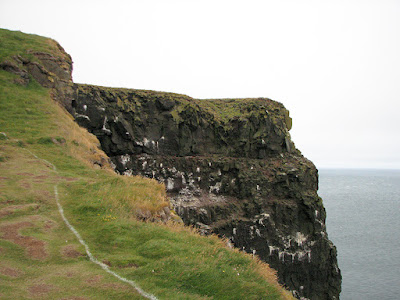

It was quite windy and cold the evening we were there. As you can see, there was only a painted line to indicate the minimum safe distance from the cliff edge -- there were no guard rails or fences, so we could see the birds clearly and even get close to them.  But given the signage about the danger of falling off the cliff and the very strong wind, we stayed well back from the edge.


The cliffs were full of all kinds of different birds.  I think these roosting birds are guillemot.


I'm not sure what species of bird these are -- maybe gulls or kittiwakes?


The Latrabjarg cliffs are 440 meters high and 14 kilometers long. We walked up to the top, but didn't walk the whole length of the cliff (it was just too windy and cold!).  At one point, the wind shifted and we got a strong scent of rotting fish, so I guess the cold might have been a boon in some ways.


And everywhere along the cliffs, we saw puffins.


My friend Karen captioned this one, "I can't see my toes!", which makes me giggle.


Puffins are just adorable!  I took a lot of photos of puffins at the Latrabjarg bird cliffs. I'm seriously puffin-obsessed.


Did I mention that there were puffins at the Latrabjarg bird cliffs? 


Puffins nest in little holes on the tops of the cliffs, and since they aren't hunted here, they are not shy of people. I think the person in the green jacket is putting out seeds, and that's why so many puffins are gathered there.


A group of puffins has many collective nouns, including a "burrow", "circus", "colony", "improbability", and "puffinry" of puffins. via
I love the idea of an improbability of puffins!  Except that I guess they aren't so improbable, since I finally got to see them.  

Waterfall by the side of the road
on the way back from Latrabjarg

There is water everywhere in Iceland. Iceland is surrounded by the ocean. Parts of the country are covered by glaciers. Boiling-hot, sulphuric water spurts up in geysirs or puffs out clouds of steam from fissures in the rocks. And everywhere, there are waterfalls. Large and powerful, small and quiet, water streams down from the mountains. This waterfall was so beautiful that we actually turned around on the highway and drove back to take photos of it. It's not a famous waterfall or a tourist attraction -- just part of Iceland's natural beauty.


I loved the vibrant greens of the mosses growing around the waterfall.  Our next day's journey would take us to a larger and even more beautiful waterfall.  

Saturday, October 3, 2015

Reykjavík, Iceland

Where to go for vacation this summer?  We remembered the gorgeous photos we had seen of Iceland, and thought that would be the perfect place to escape the urban heat and humidity of August in Maryland.  So we planned a week-long trip to Iceland.  It's not a very large country (about the size of Ohio), but we didn't want to have to rush through our sightseeing, so we decided to just focus on seeing the western side of the country.  This turned out to be wise, since driving on the often-unpaved roads, with switchbacks up and down the mountains, took much longer than we expected.

(Note that you can click on any of the photos to enlarge them.)

Harpa concert hall (Reykjavík, Iceland)

Our first evening in Iceland was spent in Reykjavík. We wandered around the harbor area (near our hotel) and came across this dramatic building. It is Harpa, the new and award-winning concert hall. I loved the way the sun glinted off the glass panels.

Harpa concert hall (Reykjavík, Iceland)

Here is another view of the street side of Harpa concert hall. The design almost looks like a glass honeycomb.

From inside the Harpa concert hall (Reykjavík, Iceland)

From the inside of Harpa concert hall looking up through the crystalline ceiling, the effect of the light through the complex glass paneling is quite striking. It really is an unusual design. Plus, there was a very nice gift shop in the lobby.

Harpa concert hall (Reykjavík, Iceland)

This is the Harpa concert hall from the harbor side. Look at all the pretty colors reflected from the glass panels!

Troll puppets (Reykjavík, Iceland)

Icelandic folklore is full of tales of huldufólk (hidden people or elves) and other creatures, such as these larger-than-life trolls in front of one of the tourist shops. Many Icelanders still believe in the huldufólk -- there have been cases of construction work stopped or redirected so as not to disturb the elves living in that area. We saw one hill with a number of little wooden houses on it, which are often put out in Icelandic gardens for the huldufólk.


Of course, after seeing the wonderful troll puppets, we had to go into the shop, where Q found this adorable puffin hat. We resisted buying it, though it would have been quite the statement hat for him to wear to work.

Hallgrímskirkja (Reykjavík, Iceland)

We walked up to Hallgrímskirkja, the largest Lutheran church in Iceland. The modernist design is very striking, and apparently is meant to represent the basalt lava flows in the Icelandic landscape.  (You can see some amazing basalt columns from all over the world here.)  The interior of the church features an enormous, 5275-pipe organ (we didn't get to see the interior, though).


And on our way to Hallgrímskirkja, Q found a cat to pet.  The cat rests on a step reading "Love and Peace" -- an invitation to be petted, surely.


Apparently, cats rule Reykjavik. At least that is what the t-shirts claim.


One of the delightful aspects of visiting Iceland in the summer is the extended daylight hours. This photo was taken around 11:00pm -- the tail end of a long, lovely sunset on our first day in Iceland.


We took one last look at the sunset over the harbor as we walked back to our hotel.

Monday, November 17, 2014

Czech Holiday Costumes & Customs (Musaion, Prague)

In addition to showing folk art, costumes and tools, the Musaion (Ethnographic Museum) also had exhibits related to the major religious holidays. Many of the costumes and practices were derived from pre-Christian traditions, including themes of nature and respect for ancestors.  The signage at the museum didn't include specific details about the particular costumes, so I did a bit of internet research and turned up a number of unusual Czech folk traditions.