After many hours of driving from Landmannalaugar, we finally arrived at our lodging in Borgarnes (past their check-in time, but thankfully, they were willing to stay open for us). As we unloaded our luggage, we were greeted by a Very Friendly Dog. While we were never introduced, the dog clearly loved people and wanted to play. At one point, Q said "I wish I had a stick to throw for you." The Very Friendly Dog perked up its ears, as if to say "Stick? I have a stick! Wait -- I'll go get my stick!"
The Very Friendly Dog then proceeded to teach Q how to play Stick. They had a great time playing in the meadow.
Who can resist that sweet face? The Very Friendly Dog was just one of many creatures we encountered during our travels in Iceland.
As we left the following morning, we spotted Icelandic horses in the field next to the inn. We saw lots of horses as we drove through Iceland, particularly in West Iceland. Horseback riding is an activity enjoyed by Icelanders and tourists (we didn't do any riding, but we enjoyed seeing the horses).
Icelandic horses in West Iceland
Icelandic horses are a unique breed. They are relatively small in stature and are adapted to the harsh climate with a double coat to protect against cold temperatures. They are the descendants of the horses brought to Iceland by the original Scandanavian and Norse settlers. Horses were the only means of transport for many hundreds of years in Iceland.
Icelandic horses in West Iceland
Icelandic horses have a wide range of coloration. Because livestock cannot be imported into Iceland, the horses are protected from most diseases and parasites. Icelandic horses, if they leave the country, cannot return.
Icelandic horses in West Iceland
Icelandic horses have two additional gaits, beyond those of other horse breeds. In addition to walk, trot, canter, gallop, they are capable of a lateral, ambling gait called a tölt, and a fast, smooth skeið gait (or "flying pace").
The most ubiquitous animal we saw, though, was sheep. They were scattered across the landscape, so commonplace that we noted their absence more than their presence. We started taking bets on how long it would be before we saw another one. We announced their presence by calling out, "Sheeeeep! SHEEEEEEEP!" to each other. Some parts of Iceland have more sheep than people (a pattern we noted in the West Highlands of Scotland, as well). Anywhere that had even the barest hint of greenery seemed to sport sheep. They slept by the side of the road. They wandered out into the roadway (another excellent reason to observe the speed limits in Iceland). Sometimes, they ran at the sound of the car or stared at us as we passed by.
But mostly, they just ignored us and went about their sheep-y business.
I got this tiny felted sheep (made by Steinunni Steinars) at the Borgarnes' farmers market. Isn't it adorable? It sits on the kitchen windowsill, along with the wooden sword swallower and pig that were my mother's, so that I can see them every day as I wash dishes. And whenever I see it, I can call out:
but rarely admit the changes it has gone through to achieve that beauty.”
-- Maya Angelou
The butterfly is a symbol of transformation, even of spiritual rebirth. We can start as a lowly, unassuming caterpillar but emerge from the chrysalis as a beautiful, winged creature. But what happens in between? It turns out that we don't entirely know. And maybe we don't really want to know. Because what happens in the chrysalis is that the caterpillar turns into goo. Yes. Soupy goo. And while that is really intriguing, from a scientific standpoint (Wow! How does that goo become a butterfly?), it is kind of, well, unappealing.
That's the problem. We love to see the transformation, to celebrate the amazing potential for change, but we don't want to know the process, particularly if it shatters our illusions. Millions of people watch the The Biggest Loser for its displays of dramatic weight loss, but I'm betting that fans would probably rather not be confronted with the show's brutal treatment of contestants. We'd rather just applaud the transformation from fat to thin than be confronted with the realities of what that entails. Shape magazine, for example, features "success stories" of weight loss, but refused to include a photo of one woman in a bikini, presumably because her belly skin showed the aftereffects of extreme weight loss. They'd rather hide that part of her story, to present an idealized version of her weight loss. We'd rather imagine that the transformation from obese to skinny is flawless and simple -- a modest effort of diet and exercise, and the perfect trim body is revealed! But it's not true. Radical transformation is often grueling, and it leaves its mark.
When we focus solely on the before-and-after, ignoring the process of transformation, we create a fantasy that change is easy to achieve. This creates false hope . . . and crushing disappointment for those who expect to transform seamlessly and effortlessly.
We'd rather believe that someone is a "natural beauty" than acknowledge the time and money and pain that is often involved in achieving cultural beauty standards. Historically, women have been encouraged to endure dangerous, costly, and time-consuming procedures to become beautiful, but then also to pretend that they look this way naturally. Don't admit to coloring your hair or getting cosmetic surgery. Don't complain about the pain of high-heeled shoes or bikini waxing. Don't acknowledge the hours of effort that went into your hair and makeup and clothing. Oh, I just rolled out of bed looking like this. We demand not only that women transform to be beautiful but also that they then lie about it.
When I discuss social change movements with my students, they are often unaware of the long-term, difficult struggles that were necessary to enact change. My students will say that the United States government "gave women the right to vote," rather than acknowledging the decades of struggle by committed suffragists who marched, were harassed and arrested, facing harsh treatment in prison. Women like Alice Paul, who went on a hunger strike in jail and was painfully and dangerously force fed, are simply erased in the narrative that the government somehow spontaneously recognized the error of excluding women from equality under the law. Change is difficult. The process of social change can be ugly and brutal. But to ignore the realities of history is to deny the work and suffering of those who fought for social justice.
Life is not a series of static before-and-after photos. Life is a process of change and development. Let science and history and psychology reveal to us the real truth of change, in all its complexity, both beautiful and ugly. I want to know the changes the butterfly went through. I think we all need to know.
****************************************
Notes on making these pieces:
I started with the quote and a photograph of an Owl butterfly I took when we visited the Butterfly Conservatory at the American Museum of Natural History in New York City. The quote was an obvious fit with the photo, so that part was easy. I did a bit of clean-up of the photo in Photoshop (cropping, fixing contrast, and using the filmgrain filter, which brightened the greens and made the colors pop more). The photo and the quotation were printed on my Epson C88+ printer, using pre-treated fabric sheets.
I got three of the pieces started, but not finished, before my studio renovation, so they sat in limbo for about two years. I have been eager to get back to these and finish them, but then had a bit of trouble getting started sewing after such a long hiatus. So they have had a long mellowing process. *grin*
(Note that you can click on the photos to enlarge them.)
Beauty of the Butterfly #1 (approx 5.9 x 8")
I started with this piece, which includes improvisational crazy piecing and raw-edge applique (using fusible web) onto a base of Timtex stabilizer (which was the base used for all the pieces). I did some hand-embroidery to frame the appliqued fabrics, including back stitch (which I haven't done in a while) and french knots. As with all the pieces, the quotation was fused and then edge-stitched using decorative machine stitching, backing fabric was added, and the entire piece was machine edged with a zig-zag stitch.
Beauty of the Butterfly #2 (approx 5.75 x 8")
For this piece and the next one, I explored sliced strata: sewing strips of fabric together to create a striped unit, which is then cut at various angles and sewn back together with additional fabric strips as inserts. I was inspired by Rayna Gillman's work (although only in general approach -- the final pieces don't look like her work at all). I added machine stitching (with metallic thread) and some hand embroidery (using ArtFabrik's hand-dyed thread).
Beauty of the Butterfly #3 (approx 8.38 x 6.25")
This piece used the sliced strata, but with a a portrait orientation to emphasize the verticality of the insert strips (well, diagonality, I guess, since they aren't truly vertical). I also mounted the butterfly photo on a separate piece of Timtex, added fabric binding, and then sewed it down to the main piece. I wanted to try framing the photo separately as its own piece, rather than embedding it within the larger piece.
This separateness was enhanced by bead embellishment -- I created a picot edge using gold beads around the "framed" photo, and added seed beads, bugle beads, and glass leaf beads on the surface of the "frame." Doing the edging proved more difficult than I expected because I did the beading after the photo was sewn down to the main piece. Hand sewing through two layers of Timtex and four layers of fabric was challenging (I broke one needle and bent another), and I had to bring up the needle at an angle to get to the edge. Next time, I might do some of the beading before mounting the piece (although it can be hard to machine stitch without hitting the beads). I also found carrying the edging around the corners challenging (this was my first attempt at a picot edge) -- I might explore other options for the corner treatment in future pieces.
The beading around the photo needed to be carried into the larger piece, as well, so I included some seed beads on the strata. I like the dimensionality that was created through the separate photo framing and bead embellishment.
Beauty of the Butterfly #4 (approx 6.15 x 8.25")
Here I went back to improvisational crazy piecing, but using the leftover strata pieces and trying to create greater value contrast with the bright green insert strips. The fabric pieces crossed over the photograph to connect with the diagonal lines of the grass in the photo. Unfortunately, that also cut off part of the butterfly wing. So I printed out the butterfly photo on organza and fused the organza butterfly over the photo. It creates an interesting effect -- the photo is a bit blurry, but also has more depth. (The artist Wen Redmond uses organza to enhance photos on fabric, which gave me the idea.) I added machine stitching and hand embroidery (seed stitch and french knots, using ArtFabrik's hand-dyed thread).
Beauty of the Butterfly #5 (approx. 6.5 x 8.25")
For the last piece, I wanted to go in a different direction, so I created a landscape -- or really, a grass-scape, I guess. I was inspired by Laura Wasilowski's Craftsy class on fused collage landscapes (although I didn't strictly follow her process, nor does the piece look like her work). I used hand-dyed fabric from Cherrywood -- my first time using their fabric, but certainly not the last. I love the rich color and depth of their fabrics. After prepping the fabric with fusible web, I cut out grassy shapes freehand and layered the pieces to create a field of different green grasses. I used a gray for the sky to blend in with the photo background, and fused a cloud shape from the gray fabric and one from the organza photos I had printed to create a cloud-shadow. Then I did lots of machine stitching -- I edged the cloud shapes and did lots of "grass-stitching" in the green shapes to create texture. I really like how it came out!
If you would like to be eligible for this week's Inspirations giveaway (for the card pictured at the top -- Beauty of the Butterfly #2), just leave a comment on this post by Sept. 6, 2015. Be sure that I have your email address so that I can notify you if you are the winner. I'll do a random draw and announce the winner during the following week.
As I mentioned previously, the Musaion in Prague had quite an extensive collection of Czech folk costumes (see my earlier posts here, here, and here).
In this post I'll include photos of individual garments and accessories
from the Musaion collection. (You can click on the photos to enlarge them, if desired. My apologies for the poor quality of some of the photos -- what with
low lighting and reflections from the glass, it's hard to get good
photos in museums, at times.)
As I mentioned in an earlier post, I have a bit of an obsession with hats, so I took photos of some of the Czech hats at the Musaion (Ethnographic Museum) in Prague. (My apologies for the terrible pun in the title of this post -- I blame the t-shirts we saw in Prague emblazoned with "Czech this out!") (Note that you can click on any of the photos to enlarge them.)
Here
is a closeup of one of the hats in the wedding tableau (you can see the whole tableau in the photos at the end of my previous post). Isn't it
wonderful? I love the tiny size and the elaborate interweaving of
ribbon and beadwork. I so want a hat like this -- although I know it
would look ridiculous on me. The shiny beads and ribbon remind me of some of the Polish hats I saw at the Ethnographic Museum.
The Musaion (Ethnographic Museum) in Prague has an extensive collection of Czech folk costumes dispersed through a number of different rooms and display cases. It was interesting to see the similarities and differences from the Polish folk costumes at the Ethnographic Museum in Kraków. I also found a list of the key differences between Czech and Slovak costumes here -- number 13 on the list is "If woman has a really giant bow attached to her head, it’s Czech." Note the enormous bow on the costume pictured above.
I love the fanciful quality of design lines that extend well beyond the frame of the body. It looks as if she could fly away on the first stiff wind. Or maybe the bow can become a propeller and she just skims along the ground like a low-flying helicopter.
(Remember that you can click on the photos to enlarge them, if desired.)
In
addition to showing folk art, costumes and tools, the Musaion (Ethnographic Museum) also had
exhibits related to the major religious holidays. Many of the costumes and practices were derived from pre-Christian traditions, including themes of nature and respect for ancestors. The signage at the museum didn't include specific details about the particular costumes, so I did a bit of internet research and turned up a number of unusual Czech folk traditions.
On our fifth day in Prague, we walked to Petřín Hill, a large public
park. On our way, we looked in at the Lego Museum. While we didn't
actually go in to see the museum exhibits, we ogled the Lego kits in the
shop and admired this mural, made entirely of Legos.
View from the Legion Bridge (Most Legií) over the Vlatava River
On our way to Petřín Hill, we crossed over the river via the Legion
Bridge, which was virtually empty of pedestrians (compared to the crush
of the Charles Bridge). This photo is looking toward the Charles
Bridge. You can see beautiful pictures of the Legion Bridge here.
As I perused the folk costumes at the Ethnographic Museum in Kraków, I was enchanted by the elaborately decorated hats. I've written before about how I used to wear and collect hats. Although I don't collect hats any more and rarely wear them, I guess I still have some inner hat lust that emerged at the sight of these beauties.
More than most accessories, hats seem full of symbolic and cultural significance. As we were traveling, we visited synagogues, where Q was required to cover his head, and cathedrals, where he was asked to remove his hat to uncover his head. Wearing hats can denote respect or disrespect. Historically, women's hats have often been derided as silly fashion accoutrements, and yet a woman wasn't considered fully dressed without an appropriate hat. Each type of hat has its own meaning -- the cap, the fedora, the bowler, all call to mind different situations and different types of people. (In one episode of the British sitcom, Are You Being Served?, they discuss specific rules about who is allowed to wear which type of hat, based on their rank in the company, for example.) Consider this quote from Bella Abzug:
I began wearing hats as a young lawyer because it helped me to establish
my professional identity. Before that, whenever I was at a meeting,
someone would ask me to get coffee. -- Bella Abzug
The hats at the Ethnographic Museum seemed more like the kind one would wear on festive occasions, rather than an everyday accessory. But as the museum signage notes, folk costumes carry a great deal of meaning about one's social place, so without a more detailed understanding of traditional Polish culture, I can't speak to the cultural significance of the hats. But I can enjoy the artistry and adornment they represent.
When I'm looking at clothing in museums, I'm always on the lookout for Delightful Details -- those little touches that make all the difference in the garment. I'm particularly drawn to embellishment: Embroidery, beading, and other types of surface design make my heart sing. The Polish folk costumes at the Ethnographic Museum were full of embellishment and I tried to capture as many details as possible while I was there. There is so much inspiration here -- I am excited about the idea of translating these folk designs into more contemporary clothing embellishment and textile art.
Remember that you can click on the photos to enlarge them. (My apologies for the quality of some of the photos -- it's hard to get good photos in museums at times.)
This vest features seed beads and sequins to create floral designs
and shirt buttons (they look like mother-of-pearl to me) to outline the
petals at the bottom of the vest. I also like the triangle points at
the top of the vest, which create an interesting neckline.
Folk costumes at the Ethnographic Museum (Kraków, Poland).
The next day we spent the morning at the Rynek Underground museum (as I
mentioned in an earlier post) and then walked back to the
Kazimierz district to see the Ethnographic Museum, housed in the former
town hall building.
The museum had reconstructed interiors and models of homes and workshops (e.g., a fulling mill), tools and implements
related to agricultural work and craft, and displays of folk art, such
as nativity scenes (more szopka!), decorated eggs, and a special
exhibition of woodcuts. However, I was mostly interested in the
costumes.
The museum had a whole room devoted to folk
costumes, and I spent a happy hour or so there, taking photos of
costumes and embellishment details. Luckily, there was also a comfy
sofa, so that Q could sit and wait for me to be done ooh-ing and
ah-ing over the costumes. The exhibit also had a nice general
summary of Polish folk costume, noting that: "Costume was of primary
importance in folk culture. It helped to determine social status, area
of residence, marital and financial status of a person wearing it. The
function of a festive attire made people spare no effortmor [sic]
expense on it. Costume is one of the leading elements in folk art."
See? My interest is justified, both at an artistic and anthropological level.
We had another beautiful day to explore Wawel Hill, the site of Wawel
Castle and Wawel Cathedral. This Gothic cathedral held coronations,
royal funerals and entombments for centuries.
The tower on
the left is a clock tower, topped by a Baroque spire (18th century) and
statues of saints Wacław, Adalbert, Stanislaw, & Kazimierz. The
tower on the right is a bell tower.
But behind it (not visible from this angle) is Zygmunt/Sigismund Tower which holds the Zygmunt/Sigismund Bell, the largest historic bell in
Poland. It is 2m high, 2.5m in diameter and weighs 11 tons (the clapper
alone weighs 350kg). It takes eight strong people to ring the bell.
We walked up the twisty and narrow stairs to see it and it is indeed
huge and heavy-looking. You can see the bell and hear how it sounds
here.
Photos were prohibited inside the Cathedral, so I can't show you the
gorgeous stained-glass windows. But you can see some nice photos of the
interior of the cathedral here.
This book is chock-full of information and inspiration. The first section covers the basic materials that can be used to make fabric beads. The second section explores a number of surface design techniques, including the use of paint, dye, bleach, paintstiks, gesso, foil, stamping, and more. Then Kristal Wick explains how to make a variety of fabric beads, including basic rolled beads and more elaborate variations, such as adding rhinestones or wrapping with wire and seed beads. There are also a number of jewelry projects included to feature your newly-created fabric beads and a gallery section for even more ideas for how to use fabric beads. The instructions are clear and the book is full of photos that illustrate the instructions, step by step -- not to mention all the photos of beautiful beads and finished projects. You can see some of the pages from the book at Interweave -- just click on the "Preview" tab.
Thanks to all who visited and commented. It was very inspiring to read your comments! I'll post another Inspirations set at the end of the month, so be sure to check back for another chance to win.
I'm beginning a new series of small textile pieces that will incorporate quotations and images that reflect some aspect of the quotation -- I'm calling it my Inspirations series. I'm inspired by this new series, and I hope that the pieces inspire others as well. My plan is to make multiple versions of each piece, to explore different design variations. I think this will work well for me, as it allows me to combine the thoughtful exploration of ideas as well as experiment with design and embellishment. Plus, I'll build up a body of small works, which I am currently lacking.
Oh, and did I mention the giveaway part? I'll choose one version of each piece to give away to my blog readers (that's you!). I hope to complete a new set of pieces every month. So come back regularly to catch the giveaways! (Remember that you can sign up through a blog reader or get new posts by email -- see the links on the sidebar.)
When I was a child, I was given a dollhouse. I played with it
throughout my childhood and kept it set up even after I stopped playing with it (my younger sisters continued to play with it while I was in college). When Q and I moved in together, I set up the dollhouse in our apartment. Eventually, though, I stored the dollhouse and all its
furnishings in a closet, waiting for a time I could bequeath it to
another child.
Looking spiffy with the fresh paint --
and the open door invites us to peer inside.
f you haven't yet gotten to see the Hyperbolic Crochet Coral Reef, you should definitely make time to see it. It's an amazing installation, merging textiles, traditionally female handicraft, environmentalism, and mathematics. I also love the way the artists invited members of each community to contribute to the project. Margaret Wertheim describes he project in this TED talk:
"The purest and most thoughtful minds are those which love colour the most." -- John Ruskin
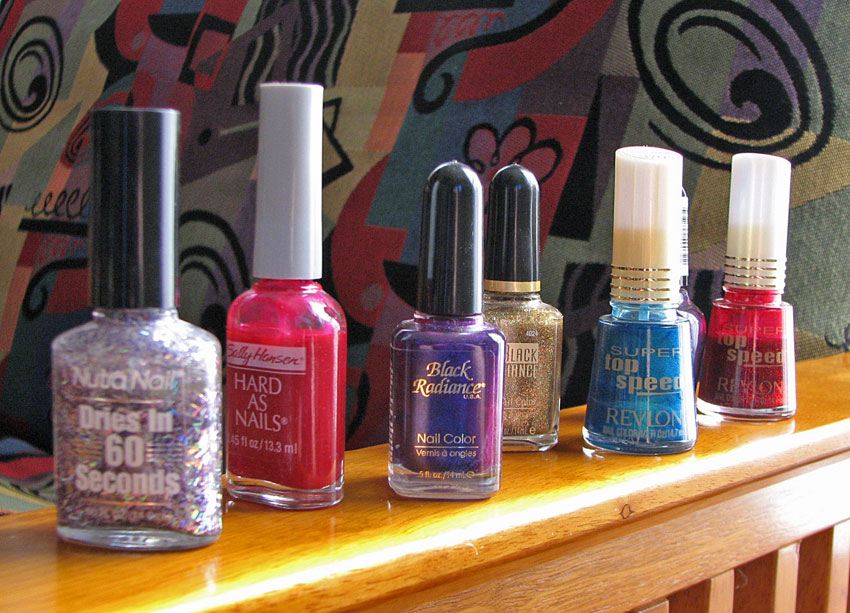
As I've mentioned before (here and here), I love color. I am drawn to bright, deep colors, compelled by them. Walking through the drugstore, my eye would be caught by the luscious metallic colors in the nail polish aisle. The fact that I hardly ever wore nail polish seemed immaterial -- how could that compete with these gorgeous shiny bottles? I finally bowed to the inevitable and gave them all away last year and have resisted buying more (thus far).
Recently I've been getting my color fix through fabric. I love making burp cloths, for example, because I get to put together bright flannels and chenille with contrasting colors of thread for the serged edging. Having the fabrics run under my fingers makes my soul sing.
I also had fun choosing fabrics to make linen dinner napkins. Who needs boring, white napkins when you can have every color of the rainbow at your table?
And, of course, my fiber fantasy scarves are full of color and texture and sparkle -- what a joy to put so many different colors together. It's like creating a symphony; each color has to live in harmony with the rest. You can see pictures of my first fiber fantasy scarf here, and pictures of my fringe madness scarf here (check out the riotous color). I'm working on a scarf now in blues and greens, turquoise and teal (oooh, love that combo); I'll post pictures soon. I also made one in earthtones with copper accents and a bit of red for zing:
And, of course, colorful flowers are always a delight. In the midst of winter, my Christmas Cactus offers a profusion of bright pink petals that look ready to take flight.
November, 2009
And one can find cut flowers and bouquets everywhere.
From a bouquet we sent to my grandmother for her last birthday (November, 2010)
Blue roses (on display at Cedar Ridge for their gala event, November 2010)
Isn't this bouquet from my father and his wife lovely? (November, 2010
Now that spring is here, brightly blooming flowers are popping up in my garden; Q says they are like fireworks, exploding into full bloom one after another.
I want to live a life infused with color. Why shouldn't we be surrounded by gorgeous color in everything we do? I believe that everyday items should be beautiful, so that we can have joy in our daily activities. My philosophy is similar to that of the Art Nouveau movement, which held that art should be a part of everyday life. Of course, napkins and burp cloths and flowers are not art, but they remind us that the elements of art (color, design, value, meaning) can be found all around us and that our environment impacts our experience. We should design all aspects of our environment purposefully to enhance the quality of our lives. For me, that means a life rich with color.
"The whole world, as we experience it visually, comes to us through the mystic realm of color." --- Hans Hofmann
"Color possesses me. I don't have to pursue it. It will possess me always, I know it. That is the making of this happy hour: Color and I are one. I am a painter." --- Paul Klee
"Colour is my day-long obsession, joy and torment." -- Claude Monet
If you need a burst of color in your life, check out the items for sale in my Etsy shop.
The annual Montgomery College Women's Studies Program Scholarship Breakfast is on Wednesday, Mar. 9 (8-9:30am), which showcases the achievements of Women's Studies students and faculty. In fact, this year, I am one of the faculty being honored -- I will be one of three faculty members receiving the On Her Shoulders We Stand Award. This award is given to those who have contributed significantly to the Women's Studies Program, and I am tremendously pleased to be receiving this recognition. It is truly an honor to receive an award for doing work that is so meaningful to me and that I love so well. I am fortunate to have such wonderful colleagues and fabulous students, as well as an incredibly supportive partner, who doesn't complain about my long hours at work and shows up every year for our V-Day production. Thanks, Q!
The event is also a fundraiser for the Women's Studies Scholarship fund, and I am coordinating the silent auction part of the breakfast. Thanks to our generous donors, we have a wonderful array of items for the auction, and all proceeds from the auction go toward student scholarships. The auction has a diverse range of items, including jewelry, ceramics, textiles, vintage items, stained glass, watercolors, housewares, and accessories. If you see something you want, I am happy to arrange a proxy bid for you. Just email me by Tuesday, Mar. 8 at 5pm to let me know what item you wish to bid on and how high you are willing to bid. Click on the individual pictures to see more details about each item, including the estimated value and the minimum bid.
My contributions to the silent auction included some of my own textile creations.
Set of four burp cloths (green and blue bubbles)
Set of four burp cloths (red stripe and bookbinder red)
Set of four autumn leaves placemats with matching tangerine linen napkins
Let's hope for enthusiastic bidding so that we can fund even more scholarships for next year!