Friday, March 25, 2011
The Meaning of Moaning
It's that time again -- V-Day season -- and I'm working with students and faculty to put together the Montgomery College production of Eve Ensler's "The Vagina Monologues", which will be on Wednesday, March 30 at 7:00pm in the Theatre Arts Arena at Montgomery College (Rockville, MD). I'll be performing with a new piece for me, one I have wanted to perform for a while. This monologue features a sex worker, a dominatrix who works exclusively with women, and who is obsessed with women's moans. I particularly like the narrative because it includes a fascinating analysis of the source and meaning of moaning, which appeals to my intellectual nature. At the end, she demonstrates an array of different types of moans. This typically elicits howls of laughter from the audience and can be a show-stopper when done really well. (But no pressure, right?) I'm enjoying the challenge of working on this piece, but it also got me thinking about our reaction to women's moans. Why do they generate such a strong response?
Our response to women's moaning is, in part, reflective of our broader cultural ambivalence regarding sexuality, and women's sexual pleasure in particular. Our culture has considerable discomfort about public displays (or even discussions) of sexuality, so this litany of moans is bound to be a little uncomfortable for some. Moreover, we have particularly ambivalent attitudes regarding women's sexual pleasure. In many (but not all) cultures today, women are expected to experience sexual pleasure; indeed, part of a heterosexual man's sexual prowess is measured by his ability to bring his female partner to the height of ecstasy during lovemaking. Yet, if she is too demonstrative in her pleasure, she risks being seen as wild, oversexed, loose, a bad girl: a slut. (The remnants of the sexual double standard at work here.) In other words, she should enjoy sex, but not too much. So women's moaning is fraught with meaning, as it is presumably evidence of her sexual pleasure. She mustn't moan too much or too loud, but some discreet moaning will be met with approval, even approbation . . . if it is genuine.
As a demonstration of pleasure, moaning is also suspect, since it can so easily be faked. Women's sexual pleasure is often viewed with suspicion. Given the significance of women's sexual pleasure and our general belief that women don't want or enjoy sex as much as men do, it is easy to understand why we think women may "fake" pleasure. (This fear is not unwarranted: One study [Elliott & Brantley, 1997] found that 60% of heterosexual, and 71% of lesbian or bisexual, college women reported faking orgasm at some point. On the other hand, we could be suspect of men's pleasure, too, as 17% of heterosexual, and 27% of gay or bisexual college men reported that they had faked orgasm at some point.) The classic scene from the film When Harry Met Sally in which Sally gives an extended performance of sexual pleasure that is obviously fake illustrates the cultural anxiety surrounding signs of women's sexual enjoyment.
In her book Hard Core: Power, Pleasure, and the "Frenzy of the Visible", Linda Williams (1989) argues that the central dilemma of pornography is how to represent women's sexual pleasure. While (presumably authentic) male pleasure can be visibly demonstrated by erection and ejaculation, "the visual terms of the cinema do not allow the female protagonists of hard-core films to authenticate their pleasure" (Williams, 1989, p. 32). While the woman may moan and writhe in the film, how do we know it's for real? Hard-core films then rely on other cinematic mechanisms to putatively reveal women's sexual pleasure, often using displays of male pleasure as though they are intrinsically representative of female pleasure (hence, the use of the money shot).
So it is not surprising that the litany of moans given on stage during "The Vagina Monologues" would generate a strong reaction. The monologue highlights the sexual pleasure of women, about which we already have considerable ambivalence (too much = slut; too little = frigid). The sexual pleasure is being given by a woman to another woman, with no man involved. If women don't need men for sexual pleasure, that threatens men's status as the ultimate source of women's sexual pleasure and undermines one of the core pillars of masculinity (as defined in our culture). The moans in the monologue are obviously fake, highlighting the concerns about the authenticity of women's sexual response (if she can fake it this convincingly on stage, then maybe all my lovers have been faking it too). In other words, the monologue foregrounds anxieties about the authenticity of women's sexual response, which further undermines the degree to which a man can be sure of his sexual prowess, and hence, his masculinity.
With all that going on, of course we guffaw -- what else can we do? Eve Ensler has found a way to get to the heart of our cultural anxieties surrounding sex and gender, but in such a way that we can laugh at ourselves. The humor is deftly woven through the show, giving us a way to release some of our discomfort as our assumptions regarding women's sexuality are challenged and we learn about the diversity of women's experiences. The show is a powerful experience, for performers and audience alike, but it is also a lot of fun. I am, as always, struck by the capacity of V-Day to educate, transform, and entertain.
I hope to see you at the show!
References:
Elliott, L., & Brantley, C. (1997). Sex on campus. New York: Random House.
Williams, L. (1989). Hard core: Power, pleasure, and the "frenzy of the visible." Berkeley: University of California Press.
Sunday, March 20, 2011
Color Junkie
"The purest and most thoughtful minds are those which love colour the most." -- John Ruskin
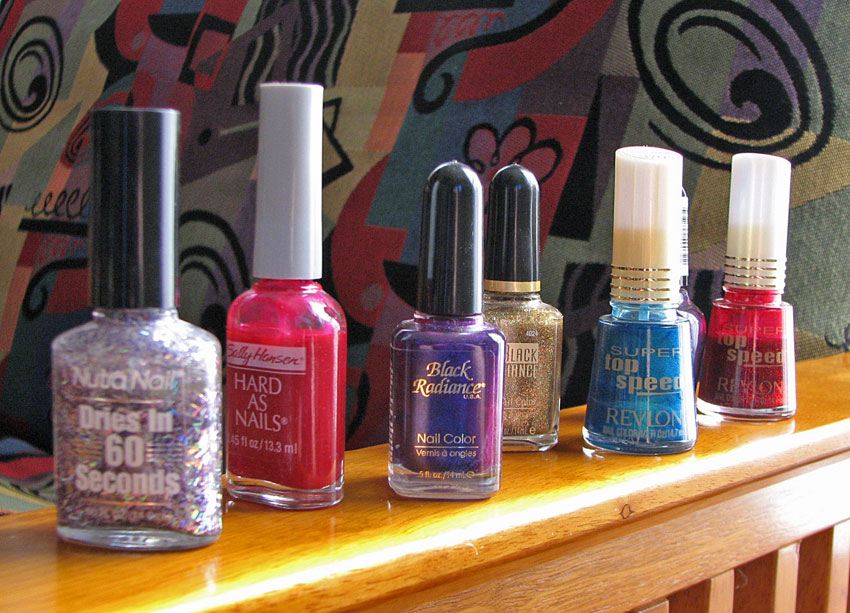
As I've mentioned before (here and here), I love color. I am drawn to bright, deep colors, compelled by them. Walking through the drugstore, my eye would be caught by the luscious metallic colors in the nail polish aisle. The fact that I hardly ever wore nail polish seemed immaterial -- how could that compete with these gorgeous shiny bottles? I finally bowed to the inevitable and gave them all away last year and have resisted buying more (thus far).
Recently I've been getting my color fix through fabric. I love making burp cloths, for example, because I get to put together bright flannels and chenille with contrasting colors of thread for the serged edging. Having the fabrics run under my fingers makes my soul sing.
I also had fun choosing fabrics to make linen dinner napkins. Who needs boring, white napkins when you can have every color of the rainbow at your table?
And, of course, my fiber fantasy scarves are full of color and texture and sparkle -- what a joy to put so many different colors together. It's like creating a symphony; each color has to live in harmony with the rest. You can see pictures of my first fiber fantasy scarf here, and pictures of my fringe madness scarf here (check out the riotous color). I'm working on a scarf now in blues and greens, turquoise and teal (oooh, love that combo); I'll post pictures soon. I also made one in earthtones with copper accents and a bit of red for zing:
And, of course, colorful flowers are always a delight. In the midst of winter, my Christmas Cactus offers a profusion of bright pink petals that look ready to take flight.
And one can find cut flowers and bouquets everywhere.
Now that spring is here, brightly blooming flowers are popping up in my garden; Q says they are like fireworks, exploding into full bloom one after another.
I want to live a life infused with color. Why shouldn't we be surrounded by gorgeous color in everything we do? I believe that everyday items should be beautiful, so that we can have joy in our daily activities. My philosophy is similar to that of the Art Nouveau movement, which held that art should be a part of everyday life. Of course, napkins and burp cloths and flowers are not art, but they remind us that the elements of art (color, design, value, meaning) can be found all around us and that our environment impacts our experience. We should design all aspects of our environment purposefully to enhance the quality of our lives. For me, that means a life rich with color.
"The whole world, as we experience it visually, comes to us through the mystic realm of color." --- Hans Hofmann
"Color possesses me. I don't have to pursue it. It will possess me always, I know it. That is the making of this happy hour: Color and I are one. I am a painter." --- Paul Klee
"Colour is my day-long obsession, joy and torment." -- Claude Monet
If you need a burst of color in your life, check out the items for sale in my Etsy shop.
As I've mentioned before (here and here), I love color. I am drawn to bright, deep colors, compelled by them. Walking through the drugstore, my eye would be caught by the luscious metallic colors in the nail polish aisle. The fact that I hardly ever wore nail polish seemed immaterial -- how could that compete with these gorgeous shiny bottles? I finally bowed to the inevitable and gave them all away last year and have resisted buying more (thus far).
Recently I've been getting my color fix through fabric. I love making burp cloths, for example, because I get to put together bright flannels and chenille with contrasting colors of thread for the serged edging. Having the fabrics run under my fingers makes my soul sing.
I also had fun choosing fabrics to make linen dinner napkins. Who needs boring, white napkins when you can have every color of the rainbow at your table?
And, of course, my fiber fantasy scarves are full of color and texture and sparkle -- what a joy to put so many different colors together. It's like creating a symphony; each color has to live in harmony with the rest. You can see pictures of my first fiber fantasy scarf here, and pictures of my fringe madness scarf here (check out the riotous color). I'm working on a scarf now in blues and greens, turquoise and teal (oooh, love that combo); I'll post pictures soon. I also made one in earthtones with copper accents and a bit of red for zing:
And, of course, colorful flowers are always a delight. In the midst of winter, my Christmas Cactus offers a profusion of bright pink petals that look ready to take flight.
![]() |
| November, 2009 |
And one can find cut flowers and bouquets everywhere.
![]() |
| From a bouquet we sent to my grandmother for her last birthday (November, 2010) |
![]() |
| Blue roses (on display at Cedar Ridge for their gala event, November 2010) |
![]() |
| Isn't this bouquet from my father and his wife lovely? (November, 2010 |
I want to live a life infused with color. Why shouldn't we be surrounded by gorgeous color in everything we do? I believe that everyday items should be beautiful, so that we can have joy in our daily activities. My philosophy is similar to that of the Art Nouveau movement, which held that art should be a part of everyday life. Of course, napkins and burp cloths and flowers are not art, but they remind us that the elements of art (color, design, value, meaning) can be found all around us and that our environment impacts our experience. We should design all aspects of our environment purposefully to enhance the quality of our lives. For me, that means a life rich with color.
"The whole world, as we experience it visually, comes to us through the mystic realm of color." --- Hans Hofmann
"Color possesses me. I don't have to pursue it. It will possess me always, I know it. That is the making of this happy hour: Color and I are one. I am a painter." --- Paul Klee
"Colour is my day-long obsession, joy and torment." -- Claude Monet
If you need a burst of color in your life, check out the items for sale in my Etsy shop.
Wednesday, March 16, 2011
Resistance or affirmation: What is queer?
On Saturday, I attended a conference at Morgan State University (in conjunction with BMore Proud) entitled Intersections: Sexuality, Gender, Race and Ethnicity. It was great to connect with others engaged in issues of sexuality, and I was part of a panel discussion on the complexities of sexual identity. I talked about the fluidity of women's sexuality and how that presents challenges and opportunities for the traditional models of coming out in psychology and the GLBTQ community. The other panelists included Dr. Andrea Brown, who talked about the intersection of race/ethnicity and sexual identity, with a particular emphasis on the role of the black church, and Genevieve Carminati, who discussed the (often ignored) role of social class in women's sexuality. I think we did a good job of exploring the theme of the conference and I am always inspired by working with my fabulous colleagues.
The keynote speaker for the conference was Dr. Antonia Randolph, a sociologist from the University of Delaware who discussed her research on hip-hop and what it says about race, gender, and sexuality. Her main theme was that there are "queer" elements present in hip-hop that challenge the mainstream ideals of gender and sexuality. She wasn't claiming that hip-hop artists are actually gay/lesbian/bi, nor even that they are necessarily going to be allies for GLBTQ issues. She was merely claiming that there are themes within the hip-hop subculture that are not consistent with mainstream heteronormativity.
This (infamous) kiss between Lil Wayne and Baby, for example, illustrates the strong affection male hip-hop artists openly express for each other. These close bonds between men may be coded as similar to father-son relationships, as part of a broader construction of kinship among those in street culture. Lyrics of hip-hop extol these male-male relationships, indicating their primacy even above the traditional family unit involving wives and mothers (fathers are typically absent in the world of hip-hop, replaced by the paternal care from those in the street culture).
I don't know enough about hip-hop to say whether the themes Dr. Randolph identified are typical or not. What struck me was the question of whether these are, in fact, "queer" -- that is, do they fundamentally challenge the values of mainstream culture? At one level, she is correct to say that these are non-normative, in that American (heterosexual) men are generally prohibited from expressing strong affection for other men; this affection should be directed toward heterosexual relationships and those of the nuclear family which are supposed to be the most important and central bonds for men (and women).
Yet at another level, the hip-hop narratives were completely consistent with the dominant paradigm of American masculinity. These hip-hop artists glorify a masculine subculture in which they are independent from (and dominant over) women. There is a long tradition of all-male enclaves, from the fraternity to the gang, and it has been commonplace for men to form strong bonds with each other, even though they may not always express their affection openly or directly. While it is true that the nuclear family is strongly valued in our culture, there is also a tension between the vaunted masculine independence and the ties of the nuclear family. To be a man is to be free and answer to no one, certainly not to a woman. Express too much affection for your mother and you risk being labeled a "mama's boy"; for your girlfriend or wife, and you are "whipped." Heterosexual men tread a delicate balance in our culture. They must establish heterosexual credentials by forming intimate bonds with women, but maintain their independence from women at the same time. By rejecting the nuclear family bonds for those of the street culture, male hip-hop artists stake out their masculinity. I'm a man, I can do as I like: I don't answer to my mother or my girlfriend or my wife.
So we are left with the question of whether these close relationships among men in hip-hop are countercultural or culturally normative. Do they resist cultural pressures, "queering" the text, or do they epitomize normative masculinity? I suspect they may be both. Cultural representations and practices can have multiple layers and convey divergent messages simultaneously. Our attempt to resist a cultural norm may simultaneously affirm and reject that norm. By prioritizing their relationships with other men, hip-hop artists may decenter the nuclear family as the putative core of a man's life. By doing so, they highlight the tension that the nuclear family represents for constructions of masculinity, and they create an alternative kin network of the street that continues to reify and valorize traditional models of masculinity. These relationships are a bit queer at one level, but they also serve to reinscribe the core values of gender performance at another level.
Bibliography:
Randolph, A. (2011, March). Wayne loves Baby and other queer lessons from hip-hop: Notes toward a race and sexuality research agenda. Keynote presentation at Intersections: Sexuality, Gender, Race and Ethnicity, Baltimore, MD.
Brown, A., Carminati, G., & Stearns, D. (2011, March). Sexual identities: Complex, contextual, and fluid. Panel presented at Intersections: Sexuality, Gender, Race and Ethnicity, Baltimore, MD.
The keynote speaker for the conference was Dr. Antonia Randolph, a sociologist from the University of Delaware who discussed her research on hip-hop and what it says about race, gender, and sexuality. Her main theme was that there are "queer" elements present in hip-hop that challenge the mainstream ideals of gender and sexuality. She wasn't claiming that hip-hop artists are actually gay/lesbian/bi, nor even that they are necessarily going to be allies for GLBTQ issues. She was merely claiming that there are themes within the hip-hop subculture that are not consistent with mainstream heteronormativity.
This (infamous) kiss between Lil Wayne and Baby, for example, illustrates the strong affection male hip-hop artists openly express for each other. These close bonds between men may be coded as similar to father-son relationships, as part of a broader construction of kinship among those in street culture. Lyrics of hip-hop extol these male-male relationships, indicating their primacy even above the traditional family unit involving wives and mothers (fathers are typically absent in the world of hip-hop, replaced by the paternal care from those in the street culture).
I don't know enough about hip-hop to say whether the themes Dr. Randolph identified are typical or not. What struck me was the question of whether these are, in fact, "queer" -- that is, do they fundamentally challenge the values of mainstream culture? At one level, she is correct to say that these are non-normative, in that American (heterosexual) men are generally prohibited from expressing strong affection for other men; this affection should be directed toward heterosexual relationships and those of the nuclear family which are supposed to be the most important and central bonds for men (and women).
Yet at another level, the hip-hop narratives were completely consistent with the dominant paradigm of American masculinity. These hip-hop artists glorify a masculine subculture in which they are independent from (and dominant over) women. There is a long tradition of all-male enclaves, from the fraternity to the gang, and it has been commonplace for men to form strong bonds with each other, even though they may not always express their affection openly or directly. While it is true that the nuclear family is strongly valued in our culture, there is also a tension between the vaunted masculine independence and the ties of the nuclear family. To be a man is to be free and answer to no one, certainly not to a woman. Express too much affection for your mother and you risk being labeled a "mama's boy"; for your girlfriend or wife, and you are "whipped." Heterosexual men tread a delicate balance in our culture. They must establish heterosexual credentials by forming intimate bonds with women, but maintain their independence from women at the same time. By rejecting the nuclear family bonds for those of the street culture, male hip-hop artists stake out their masculinity. I'm a man, I can do as I like: I don't answer to my mother or my girlfriend or my wife.
So we are left with the question of whether these close relationships among men in hip-hop are countercultural or culturally normative. Do they resist cultural pressures, "queering" the text, or do they epitomize normative masculinity? I suspect they may be both. Cultural representations and practices can have multiple layers and convey divergent messages simultaneously. Our attempt to resist a cultural norm may simultaneously affirm and reject that norm. By prioritizing their relationships with other men, hip-hop artists may decenter the nuclear family as the putative core of a man's life. By doing so, they highlight the tension that the nuclear family represents for constructions of masculinity, and they create an alternative kin network of the street that continues to reify and valorize traditional models of masculinity. These relationships are a bit queer at one level, but they also serve to reinscribe the core values of gender performance at another level.
Bibliography:
Randolph, A. (2011, March). Wayne loves Baby and other queer lessons from hip-hop: Notes toward a race and sexuality research agenda. Keynote presentation at Intersections: Sexuality, Gender, Race and Ethnicity, Baltimore, MD.
Brown, A., Carminati, G., & Stearns, D. (2011, March). Sexual identities: Complex, contextual, and fluid. Panel presented at Intersections: Sexuality, Gender, Race and Ethnicity, Baltimore, MD.
Monday, March 7, 2011
Women's Studies Silent Auction
The annual Montgomery College Women's Studies Program Scholarship Breakfast is on Wednesday, Mar. 9 (8-9:30am), which showcases the achievements of Women's Studies students and faculty. In fact, this year, I am one of the faculty being honored -- I will be one of three faculty members receiving the On Her Shoulders We Stand Award. This award is given to those who have contributed significantly to the Women's Studies Program, and I am tremendously pleased to be receiving this recognition. It is truly an honor to receive an award for doing work that is so meaningful to me and that I love so well. I am fortunate to have such wonderful colleagues and fabulous students, as well as an incredibly supportive partner, who doesn't complain about my long hours at work and shows up every year for our V-Day production. Thanks, Q!
The event is also a fundraiser for the Women's Studies Scholarship fund, and I am coordinating the silent auction part of the breakfast. Thanks to our generous donors, we have a wonderful array of items for the auction, and all proceeds from the auction go toward student scholarships. The auction has a diverse range of items, including jewelry, ceramics, textiles, vintage items, stained glass, watercolors, housewares, and accessories. If you see something you want, I am happy to arrange a proxy bid for you. Just email me by Tuesday, Mar. 8 at 5pm to let me know what item you wish to bid on and how high you are willing to bid. Click on the individual pictures to see more details about each item, including the estimated value and the minimum bid.
My contributions to the silent auction included some of my own textile creations.
Let's hope for enthusiastic bidding so that we can fund even more scholarships for next year!
The event is also a fundraiser for the Women's Studies Scholarship fund, and I am coordinating the silent auction part of the breakfast. Thanks to our generous donors, we have a wonderful array of items for the auction, and all proceeds from the auction go toward student scholarships. The auction has a diverse range of items, including jewelry, ceramics, textiles, vintage items, stained glass, watercolors, housewares, and accessories. If you see something you want, I am happy to arrange a proxy bid for you. Just email me by Tuesday, Mar. 8 at 5pm to let me know what item you wish to bid on and how high you are willing to bid. Click on the individual pictures to see more details about each item, including the estimated value and the minimum bid.
My contributions to the silent auction included some of my own textile creations.
![]() |
| Set of four burp cloths (green and blue bubbles) |
![]() | |
| Set of four burp cloths (red stripe and bookbinder red) |
![]() |
| Set of four autumn leaves placemats with matching tangerine linen napkins |
Wednesday, August 11, 2010
The power of stillness
One of the lessons I have learned from dance is the importance of stillness. Beginning dancers often assume that one must be continuously in motion -- keep moving, keep moving, fill up the music. But constant motion is wearying to watch and gives the viewer no time to rest. Of course, pauses do more than just give the audience a breather. Stillness provides a frame for motion. When the dancer stops moving, it serves to accent the previous move -- it lets the viewer know that something important just happened. Even the most spectacular move will not be appreciated by the audience unless they are given time to absorb it and the pause that lets them know how amazing it was (think of the "ta-da!" moment, for example). Dance also needs stillness for structure, just as language uses punctuation to break the continuous stream of words into meaningful units. Similarly, we use pauses and changing tempos to create phrasing in dance.
But these moments of stillness are challenging. As one of those people who can become uncomfortable with silence, I tend to want to fill up every moment with sound and action. Pauses create anxiety in many dancers, because they worry that the audience will get bored. We tend to think of stillness as an absence -- without movement, nothing is going on. Nothing could be further from the truth. When executed well, the pause is filled with meaning: with the memory of movement and the anticipation of movement, with the persona of the performer, with the connection between performer and audience. The quiet moments require that we have confidence in ourselves -- confidence that we alone, without the distraction of movement, have a strong enough presence to compel the viewer's interest. In this way, stillness requires that we make ourselves vulnerable; stripping off the cloak of our dance technique and putting aside our bag of tricks, we expose our self, the self we embody for performance, to the audience.
This excerpt from George Balanchine's ballet, Apollo, uses moments of stillness to create tension and heighten emotion, as well as to highlight beautiful poses.
In this piece by the spectacular dance company Momix, stillness is essential for the illusion of defying gravity. Tension is created as we wonder whether the dancers will be able to hold their position. We are able to focus on the one dancer who is moving because all of the other dancers are immobile. Notice, too, the moment at about 1:30 when the dancers hold a new position for a long moment, and the audience applauds. This is the the "ta-da!" moment I mentioned earlier. Later in the piece, moments of stillness highlight particular poses and shapes created by the dancers.
In life, as in dance, I want to keep moving, striving, doing. I don't like to just sit still and do nothing. But I'm coming to realize that we all have (or should have) pauses in life, when we are not doing, but merely being. While they may feel unproductive, these moments give us a chance to reflect on the past and envision the future, as well as to fully experience the present. Of course, just as in dance, there are more and less effective uses of stillness -- we need to fill these pauses with meaning, not just hang around doing nothing. If you find your life overfull of activity, perhaps it is time to cultivate moments of quietude. If you find yourself in a prolonged pause, make it a meaningful one and recognize that sometimes it is all right just to be, suspended between moments of doing. I suspect I will always enjoy action best, but I'm learning to appreciate the value of purposeful inactivity. Perhaps someday I can learn to live as comfortably in stillness as I do in motion, even if only for a moment, when I am my only audience.
But these moments of stillness are challenging. As one of those people who can become uncomfortable with silence, I tend to want to fill up every moment with sound and action. Pauses create anxiety in many dancers, because they worry that the audience will get bored. We tend to think of stillness as an absence -- without movement, nothing is going on. Nothing could be further from the truth. When executed well, the pause is filled with meaning: with the memory of movement and the anticipation of movement, with the persona of the performer, with the connection between performer and audience. The quiet moments require that we have confidence in ourselves -- confidence that we alone, without the distraction of movement, have a strong enough presence to compel the viewer's interest. In this way, stillness requires that we make ourselves vulnerable; stripping off the cloak of our dance technique and putting aside our bag of tricks, we expose our self, the self we embody for performance, to the audience.
This excerpt from George Balanchine's ballet, Apollo, uses moments of stillness to create tension and heighten emotion, as well as to highlight beautiful poses.
In this piece by the spectacular dance company Momix, stillness is essential for the illusion of defying gravity. Tension is created as we wonder whether the dancers will be able to hold their position. We are able to focus on the one dancer who is moving because all of the other dancers are immobile. Notice, too, the moment at about 1:30 when the dancers hold a new position for a long moment, and the audience applauds. This is the the "ta-da!" moment I mentioned earlier. Later in the piece, moments of stillness highlight particular poses and shapes created by the dancers.
In life, as in dance, I want to keep moving, striving, doing. I don't like to just sit still and do nothing. But I'm coming to realize that we all have (or should have) pauses in life, when we are not doing, but merely being. While they may feel unproductive, these moments give us a chance to reflect on the past and envision the future, as well as to fully experience the present. Of course, just as in dance, there are more and less effective uses of stillness -- we need to fill these pauses with meaning, not just hang around doing nothing. If you find your life overfull of activity, perhaps it is time to cultivate moments of quietude. If you find yourself in a prolonged pause, make it a meaningful one and recognize that sometimes it is all right just to be, suspended between moments of doing. I suspect I will always enjoy action best, but I'm learning to appreciate the value of purposeful inactivity. Perhaps someday I can learn to live as comfortably in stillness as I do in motion, even if only for a moment, when I am my only audience.
Sunday, August 8, 2010
Cease and desist
Dear Brain,
I hope this letter finds you well. I would like to begin by thanking you for the excellent service you have thus far provided. I have had little cause for dissatisfaction over these many years and have come to rely on you for everything from motor control to memory (although I must say your performance in the memory department has been rather spotty at times). Whenever I have needed you, you were there.
It is, therefore, with a heavy heart that I must register my current complaint. It must seem to you a rather trivial matter, given your otherwise exemplary performance. Indeed, I have tried my utmost to simply ignore the problem and hoped that you would resolve it spontaneously. But my patience has been stretched to its breaking point. I have reached the limits of my goodwill and cannot turn a blind eye to such egregious behavior on your part.
I have endured more than a month of near-constant replay of the same tune. It is more than I can bear. True, there have been moments, even whole days, during which I was not plagued by the endlessly repeating musical loop. But just when I think it is over, when I hope to be truly free of this torture, I find myself whistling the refrain under my breath. I have done everything I know to end this cycle. I can find nothing -- no other music, no mental trick -- to successfully expunge this earworm. I even attempted to replace one song loop with another to no avail. I must, therefore, respectfully ask you to take immediate action to end your musical barrage.
It wouldn't be so bad if the music were more complex or varied. There are some songs I could happily listen to every day. Frankly, what bothers me most is the sheer inanity of your choice. I ask you, honestly, who wouldn't be irritated by incessant replay of the theme song from I Dream of Jeannie -- a show I haven't seen for at least a decade, and one which at best is silly and might more accurately be described as puerile. I mean, really -- I'm not asking for high-brow classical music, but this is just embarrassing. What are you trying to communicate to me? Am I supposed to dress up in chiffon and live in a bottle, devote myself to servile submission to my "master" -- or are you just encouraging me to watch more television? I cannot decode the message, if any, that is being conveyed, and I have had enough.
As of receipt of this letter, I demand that you cease and desist your musical assault. Prompt action on your part will ensure that no punitive action will be taken against you. Should you fail to respond in a timely manner, I am prepared to settle this matter formally in court. I deeply regret the necessity of this letter, but you have left me little recourse. I hope that we can resolve this amicably and return to the mutually satisfactory relationship we have had in the past.
Sincerely,
Deborah C. Stearns, Ph.D.
Friday, August 6, 2010
When is it enough? Searching for meaning
![]() |
| Eye by M. C. Escher (1946) |
When you look back on your life and contemplate what you have accomplished, will it be enough? Will you have achieved enough, done enough, been enough? What is enough?
These are the questions that plague me. I have always struggled with the question of sufficiency (or what I might call "enoughness"). Am I smart enough? Am I attractive enough? Is my work good enough? I sought evidence, some kind of standard against which I could determine my quality. Unfortunately, there is no clear standard for "enoughness," because it depends on what one means by enough. Enough for what, exactly? Is my work good enough to pass the class is a different question from whether it is good enough to get the top grade. The questions never get resolved for me because I don't know what I mean by enough. I don't have some concrete goal or clear comparison that will provide a definitive answer for the question. Essentially, this stands in for the existential question of my worth: Am I good enough to justify my existence?
![]() |
| In Notre Dame des Neiges (Montreal) |
By what metric do we judge the quality of a person's life? This requires that we identify the purpose of life, a thorny question to be sure. One of my colleagues believes that the meaning of our lives is to be found in the quality of our relationships with others -- we live to love and be loved. Some have argued that we are meant to seek happiness:
“I believe that the very purpose of life is to be happy” -- Dalai Lama
Or perhaps not:
"The purpose of life is not to be happy. It is to be useful, to be honorable, to be compassionate, to have it make some difference that you have lived and lived well." -- Ralph Waldo Emerson
“Our prime purpose in this life is to help others. And if you can't help them, at least don't hurt them.” -- Dalai Lama
Maybe we are meant to fulfill our potential:
Or perhaps we should savor our life and seek diverse experiences:"When I stand before God at the end of my life, I would hope that I would not have a single bit of talent left, and could say, 'I used everything you gave me.'" -- Erma Bombeck
"The purpose of life is to live it, to taste experience to the utmost, to reach out eagerly and without fear for newer and richer experience." -- Eleanor Roosevelt
Maybe it doesn't matter exactly what we pursue, as long as we have some goal:
"The purpose of life is a life of purpose." -- Robert Byrne
But whatever life's purpose, whether love, happiness, service or savoring, we are still left with the question of what constitutes enough. If you follow Erma Bombeck's guidance, how do you know if you have fully met your potential? Did you produce your best work? Were you your best self, or could you have been better? For Emerson, how much of a difference do we need to make to have lived well? If we make a slight difference in only one person's life, is that sufficient? Can Eleanor Roosevelt be sure that she has tasted her experience to the utmost? Maybe she could have savored life more fully.
I can list my achievements and contributions, but I don't know if they are enough. Couldn't I have done more? Surely I wasted time that could have been better spent. Perhaps I should have spent more time with my students -- or maybe less time at work and more time with my family and friends. Maybe I should have focused more on one pursuit, rather than trying to do so many different things. How do I know if I have done enough? I'm searching for a sense of inner certainty that would indicate that I am on the right track, but I find only doubt. My only certainty arises from knowing that some accomplishment is definitely not enough. Without the feeling of certainty, I search for some external metric that could answer the question. I look to awards, accolades, affection, any of which might indicate success, but none of which tell me if I have done enough.
![]() |
| Courtesy of Mark's Weblog |
Maybe I'm not supposed to have the answer. Maybe it's engaging with the question that matters. After all, the open question could inspire further effort -- if I knew that I had done enough, I might get complacent and rest on my laurels. My lingering doubt provides a driving sense of anxiety -- you're not done yet, do more, try harder, keep going -- the dire threat of failure, of a meaningless and unfulfilled life, lurking at every moment. True, this worry is unpleasant, but perhaps it is useful. I believe in the importance of living an examined life, and unresolved questions keep the examination process ongoing.
But perhaps the anxiety is merely a distraction. Rather than being a goad to greater achievement, one could argue that these worries leach energy from my life's work. I spend time dithering about whether I've done enough instead of just getting on with it. What could I have gotten done with this time I've spent rambling on about my existential angst, for example? If I could come to some zen-like peace with the question of my worth, would I really stop working, or would I be even more productive?
It's a moot point, as I simply don't know how to dismiss the existential questions; I have no answers and I can't make the questions go away. The existentialist and humanistic psychologists would argue that we all confront these issues -- we must face the inevitability of our death and the threat of meaninglessness as part of psychological growth. It may be too much to ask for a definitive answer, but I could wish for a tentative one, some ballpark estimate of my life's cumulative worth as a crumb of comfort in the face of my mortality. Instead I simply ride out the ebb and flow of doubt, presuming that I am doing things right (all the while fearing that I am not). And I hope that, when I am at the end of my days, I will be satisfied with what I have made of of my life. I suspect, though, that at least some degree of doubt will follow me always, as I cannot imagine myself disentangled from the uncertainty that permeates my existence.
How about you? How do you establish whether you have done enough?
Sunday, August 1, 2010
Summer days
An afternoon splashing in the pool at my father's house with my brother and his kids
Watching butterflies and dragonflies flutter and dance
Surrounded by colorful flowers
I come home smelling of chlorine and memory.
Friday, July 30, 2010
Creating in chalk
I rarely take commissions, but while hanging out with my niece and nephew . . .
There's nothing like spending time with children to bring fresh inspiration . . . or is that desperation? ;-)
My niece asked me to draw an "alien picture" of her -- does this look alien enough?
And we created a curving hopscotch board that had 40 squares.
There's nothing like spending time with children to bring fresh inspiration . . . or is that desperation? ;-)
Fiber fantasy scarf: Fringe madness
I spent a couple of weeks sewing in preparation for a show, and I was excited to make more of the fiber fantasy scarves. I had so much fun working with the recycled sari ribbons and yarns that I wanted to make another scarf using them. I had two main goals: to create a diagonal line that avoided the typical vertical or horizontal layout of fibers and to create a more open, less dense feel for the scarf. So I laid out the sari ribbon on the diagonal, looping it back and forth. In between, I laid out recycled sari yarn and commercial yarns and ribbons, but without filling in the space fully.
I used free-motion stitching to make stylized flames in red, orange, and yellow threads, and then used heavy gold metallic thread to stitch spirals along one long edge of the scarf. The flame design doesn't really show up on the scarf, but the gold metallic shows up nicely. If I want the stitching to show up on these scarves, I need to use heavy-weight thread in a contrasting color -- otherwise, the thread blends into the other fibers of the scarf. I used a different water-soluble stabilizer for this scarf (Aquabond). I found the adhesive to be a bit weaker, but it rinsed out more easily than the Aqua-Magic I had used previously, which tends to leave behind adhesive residue. After rinsing out the stabilizer, I had to untangle the fringe (which was quite a task). Then I trimmed the fringe and hand-knotted it on all four sides of the scarf. This took a long time, but turned out to be a good task to keep me from being antsy while waiting for a doctor's appointment.
Overall, I'm pleased with how this turned out. The colors are fabulous -- the recycled sari ribbon and yarn really has intense, luscious color -- and I think the fringe gives it nice movement. It's a long scarf (about 6" wide and 54" long), which means it can be worn in quite a few different ways. At the show, this scarf attracted attention -- a number of people touched it, picked it up, tried it on. Seems like a sign of a successful design to me! The scarf is for sale in my Etsy shop.
Subscribe to:
Posts (Atom)