Showing posts with label wildlife. Show all posts

Saturday, December 5, 2015

Ísafjarðardjúp (Westfjords, Iceland)


After our stay in Ísafjörður, we drove back toward Reykjavík. The drive along the northern coastline of the Westjords (around Ísafjarðardjúp) included some gorgeous views.


The waters of the fjord were still and calm, perfectly reflecting the mountains.


We stopped to see the colony of harbor seals that lives in Ísafjarðardjúp.  They were hanging out on the rocks and little islands in the fjord.


From the shore, it was hard to see the seals clearly -- another moment I wished I had brought binoculars -- but every once in a while, they would look up or flap a flipper.


After a lunch break at Litlibaer (more about that in my next post), we hiked out to a different part of the shoreline to look at the seals again.


There were birds, too, quarreling on a nearby island.


As we stood on the rocks at the edge of the water, one seal swam past us.


The little seal swam back and forth, disappearing underwater and reappearing. It was clearly curious about us, as it periodically poked up its head and looked at us.


It was quiet and peaceful on the shore. Watching the birds and seals on the calm waters, with snow-covered mountains in the distance, we enjoyed a long moment of communing with the fjord.

A little too long, actually, as the tide came in while we were out there, and we had to wade back a bit, getting our shoes and socks soaked. A minor price to pay, truly, and I can now say that I walked through a fjord in Iceland. 

Next up: Litlibaer

Friday, December 4, 2015

Adventures with seabirds (Westfjords, Iceland)


On the drive back from Súðavík to Ísafjörður, I was on the lookout for more birds. Iceland hosts many different species of birds, particularly in the spring and summer, so I wanted to be sure to see as many different varieties as I could. Q spotted this lovely bird while we were driving and pulled over so I could get a photo.


Alas, the moment I got within 100 meters of the creature, it flew away. And that was how it went -- I could see birds at a distance, but had trouble getting close enough to get a good look (or a good photo). *sigh* Oh, for binoculars and a telephoto lens!


Still searching for birds, we caught sight of a large flock of Arctic terns. Q pulled over so I could get some photos. I was immediately identified as a threat by some of the terns, who circled above and screamed a challenge. Unnerved, I moved away. They followed, hovering just over my head and uttering threat-calls. Heart pounding, I fled into the safety of the car. I guess I should just be grateful they didn't dive-bomb me, as terns are wont to do.


Q wasn't willing to leave without getting me a chance to get close-up photos of the birds. "We'll feed them," he said, "just like the seagulls at the beach in New Jersey who went crazy for Stella D'Oro cookies!" So he grabbed a granola bar and got out of the car. There he stood, braced against the chilly wind coming off the sea, throwing chunks of granola into the air and crying out "Come get it! Nice fish for you!"

That is true love.


Sadly, though, the birds weren't really all that interested in granola. (I'm pretty sure they knew it wasn't fish.)  But I did get a few shots of Arctic terns, in amongst all the blurry photos.

Next up: Ísafjarðardjúp

Thursday, December 3, 2015

Súðavík and the Arctic Fox Center (Westfjords, Iceland)


The Arctic fox is the only indigenous land mammal in Iceland. Arctic foxes came to Iceland across the frozen sea during the last ice age. The Arctic Fox Center in Súðavík has a small museum exhibit about Arctic foxes as well as an outside pen with orphaned foxes they care for. (There is also a cafe which smelled so good!) In addition, the Arctic Fox Center (along with the Arctic Fox Research Station in Hornstrandir) conducts research related to the Arctic fox.


There are two Arctic fox color morphs: the blue and the white. The blue morph is dark throughout the year, though their fur gets bleached in late winter so they look almost white in spring. The white morph is white in winter, but brown dorsally and light gray ventrally in summer. Most of the Arctic foxes in continental parts of the world are the white morph, while the blue morph is more common in coastal areas. Most of the Arctic foxes in the Westfjords region of Iceland are the blue morph.

I included the trip to the Arctic Fox Center so that I could see an Arctic fox, as my guidebook assured me that it would be very unlikely that I would see one in the wild. Yet, late one night as we were driving to our hotel, we did see one. It was dark. We had been driving with care to avoiding hitting sheep and birds that were on the roadway, and we saw something small, low and dark dash out in front of the car. It ran ahead of us on the road for a while, and then went off into the field again. Given its size and movement, it could only have been an Arctic fox.


We were surprised that one of the foxes in the pen came right up to us. It seemed to have no fear of humans. When we asked the staff about it, one woman said that they were kind of bratty, always begging for food. Sadly, we weren't allowed to feed them.

In tundra areas, the Arctic fox largely eats lemmings and voles, and their numbers vary depending on the lemming population. In coastal areas (including Iceland), Arctic foxes eat birds, eggs, berries, and have even been known to follow polar bears to eat their leftovers. Sheep farmers in the Westfjords saw the Arctic fox as a danger to their livestock, as well (I'm assuming the foxes went after lambs).


While we were visiting the Arctic Fox Center in Súðavík, we noticed that there were bright blue balloons (and plastic cups and plates) decorating the buildings and gardens. We even came across these two blue figures behind someone's house. What is up with the blue decorations, we wondered? A quick internet search reveals that it was the International Blueberry Festival. Blueberries are the only sweet fruit grown in Iceland (everything else is imported) -- so I guess they deserve a festival!

Next up: Adventures with seabirds

Wednesday, December 2, 2015

Ísafjörður (Westfjords, Iceland)


Ísafjörður is the largest town in the Westfjords and is situated on a spit of land that is surrounded by water on three sides.  There are also tunnels on every roadway into town.  Q really liked the tunnels we went through -- they were mostly rough-hewn rock, rather than the more finished concrete or tile versions we've seen in the U.S.  At times, the tunnels narrowed to one lane, which was a bit unnerving, as we had to hope that cars would be able to use the pull-off enclaves and take turns without accident.  I couldn't get any decent photos in the darkness of the tunnel, but you can see what they look like here (you can even watch a video of driving through the tunnel).


We found a nice bakery in Ísafjörður that featured this classic car right outside. The poor woman who served us had to stretch her English skills to describe every item so that we could pick out our sandwiches.

"And it also has -- what is it called?"
"Cucumber?" I suggested.
"Yes, cucumber."

It wasn't too hard to guess, as cucumbers were served at every breakfast buffet.  They are one of the few vegetables that aren't imported, as they can be grown indoors year-round in Iceland.

We also got some tasty desserts at the bakery: A chocolate cake flavored with cinnamon and a chocolate-covered, strawberry-creme filled, gingerbread cake (which was really delicious and very sweet).


As we came out of a shop in Ísafjörður, we heard an odd noise. Looking up, we saw this pair of ravens perched on the shop building. We got to hear a number of different vocalizations -- do you know that scientists have identified up to 33 different vocalization categories among ravens? These two really seemed to be "talking" to each other. Ravens mate monogamously for life, so perhaps these were a mated pair.


Ravens have a prominent place in the folklore and mythologies of many cultures. In Norse mythology, the god Odin was depicted with two ravens (perhaps a mated pair?), Huginn (Thought) and Muninn (Memory). Every day, they flew forth to see and hear everything going on in the world, returning to whisper the information they had gathered to Odin. In this way, they were his eyes and ears.


There were a number of cloudy days on our trip, but the clouds were so often striking and sculptural that the sky just became another stunning landscape.


As we walked around the residential area of Ísafjörður that evening, we saw a pussycat across the street.  As always, Q made appropriate cat-welcoming sounds (he wants to pet every cat we find). With no hesitation whatsoever, the cat ran right over to me.  I wasn't even making cat-sounds!  Without waiting to be petted, the cat then skittered around us, moving up the street.  

We followed.  

If we turned onto another block, the cat turned with us, running until it was ahead of us, but looking back every once in a while to make sure we were still there.  In this way, we were leading and following this cat for quite some while.  She clearly wanted to be near us, but not too near us.  Her path was circuitous, weaving under and around parked cars, moving across the street and back again.  There was something mysterious about the persistent, ambivalent attentions of this creature in the twilight hours of an unfamiliar city.  Where did she want to lead us and why?  

We walked with her all the way out to the water's edge, but finally thought we should walk back to where we first saw the cat, so that she would be close to home.  When we did, we met a woman who said this was her sister's cat.  We were glad to lead the cat back home safely, though still perplexed by her behavior.      

Next up: The Arctic Fox Center in Súðavík

Tuesday, December 1, 2015

Dynjandi Waterfall (Westfjords, Iceland)


After our stay in Flókalundur, we drove up the west coast to Ísafjörður. On our way, we passed by this roadside sculpture.  I don't know what it is meant to represent, but I found it intriguing.


The clouds came down to touch the mountains as we drove north.


We drove through the clouds high on a mountain road . . . it looks like the world ends just beyond that bit of road.


Our next stop was the Dynjandi waterfall, which was my favorite of the waterfalls we saw in Iceland. It was beautiful, with lots of lovely falls and a nice hike up to the top.


We were able to get quite close to the falls. It was refreshing to be able to interact with its natural beauty without the various barriers I'm used to in the natural tourist attractions in the United States.


We could get *really* close to the falls -- if you look carefully, you can see Q in the lower right corner, right next to the water.


There were also a number of interesting plants along the hike up to the top of the waterfall.  These little puffballs were all over Iceland, creating drifts of white in the fields.  Apparently, this is Eriophorum scheuchzeri (Scheuchzer's cottongrass).


Look at all the different colors of lichen and moss on this rock!


The Icelandic plants are fragile, and tourists trampling on them can damage the ecosystem. These signs and rope barriers protected the native flora from those of us hiking up the Dynjandi waterfall.


We made it to the top! Q noted that the sound of the waterfall was not constant, but varied and included a number of different sounds, depending on the flow of the water.


Gorgeously vibrant green moss lushly textured the rocks next to the main falls.


There was an intriguing vein of red rock at the top of the falls. Ah, if only a geologist had been handy to explain it to us!


After hiking back down, we walked out to the shore and watched the Arctic terns fly over the fjord and perch on the rocks.


At some point during the hike down from the top of the Dynjandi waterfall, Q managed to zip his hoodie and rain slicker together. Upon discovering it, he said that he had inadvertently invented the world's first spiral garment.  "Now if I could zip the right side of the rain slicker to the left side of the hoodie, I'd be a Moebius strip!"

Next up: Ísafjörður

Monday, November 30, 2015

Latrabjarg Bird Cliffs (Westfjords, Iceland)


After our overnight stay in Borgarnes, we drove north to the Westfjords. We stopped at a lookout point on our way through the Breiðafjörður region that included this signage.  It tells the story of the Laxdæla saga, a love triangle that ends in tragedy.  It was a new story for me, as I wasn't familiar with the Icelandic sagas.  I couldn't figure out what this sign marked, though -- were we looking at the valley where Bolli killed Kjartan?  I do quite like the idea of celebrating famous stories with roadside markers, though.  It seems consistent with the emphasis on books in Icelandic culture.


The Westfjords are less populated and less often visited by tourists than other regions in Iceland.  It was quite a bit colder there, too, as we got closer to the Arctic circle.  The roads are often unpaved as they wind up and down around the mountains and fjords.  It takes much longer to drive than estimated by Google maps.

But even so, we took time for some side jaunts on the way to our hotel.  We drove out to Reykhólar, a tiny town with a factory and a museum.  We didn't tour the museum, but took the opportunity to sit in the cafe for coffee and a piece of decadent chocolate cake served with frozen blueberries and cream.  Later on in our drive, we passed by this turf house. I had heard about the Icelandic turf homes and wanted a closer look, so we pulled off the road so that I could stand amidst the sheep droppings and take a picture.

Eventually, we made it to our hotel in Flókalundur in late afternoon.  We dropped off our luggage and headed out again to drive to the Latrabjarg Bird Cliffs.  I was committed to getting out there so that I could get a chance to see a puffin.  Years ago, we visited Scotland (another country with puffin colonies), but we didn't go to the Northern Highlands where we could have seen the puffins.  Ever since then, I had a long-standing (jesting) pout that we "went all the way to Scotland, and I didn't get to see a puffin."  Q was going to make sure that I got to see puffins this time!


It was another long drive to Latrabjarg.  The speed limits in Iceland seem slow to an American driver, but with good reason. Even on easy roads, one is likely to encounter unpredictable sheep crossings. And many of the roads, like this one, are unpaved and winding, with blind hills and sheer drops off to one side (and few guard rails!). The sharp switchbacks along mountainous roads require slow, careful driving. So we didn't begrudge the speed limits, in most cases. This fellow was reminding us as we went through a small group of homes that we should slow down to 30kph. From a distance, the figure was very realistic -- a creative way to get the driver's attention and remind them about the speed limit.


When we finally got to the Latrabjarg bird cliffs, it was evening (although given the long daylight hours, it wouldn't get dark for some time yet).  The guide book recommended visiting the bird cliffs in the evening, as the birds would be returning to their nests at that time.  I had heard that puffins were shy -- hard to catch a glimpse of, and even more difficult to photograph.  So I feared that we would need to look around for a long time to see even a hint of a puffin.  But we got out of the car, walked from the parking lot toward the cliff edge . . . and immediately, we saw a couple of puffins.  We were even able to move toward them and take photos without having them fly away or pop down into their holes.
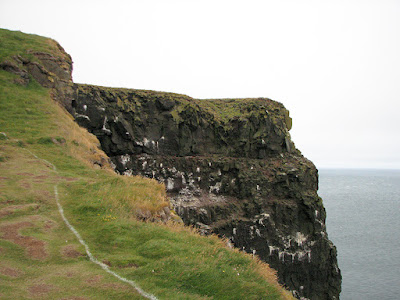

It was quite windy and cold the evening we were there. As you can see, there was only a painted line to indicate the minimum safe distance from the cliff edge -- there were no guard rails or fences, so we could see the birds clearly and even get close to them.  But given the signage about the danger of falling off the cliff and the very strong wind, we stayed well back from the edge.


The cliffs were full of all kinds of different birds.  I think these roosting birds are guillemot.


I'm not sure what species of bird these are -- maybe gulls or kittiwakes?


The Latrabjarg cliffs are 440 meters high and 14 kilometers long. We walked up to the top, but didn't walk the whole length of the cliff (it was just too windy and cold!).  At one point, the wind shifted and we got a strong scent of rotting fish, so I guess the cold might have been a boon in some ways.


And everywhere along the cliffs, we saw puffins.


My friend Karen captioned this one, "I can't see my toes!", which makes me giggle.


Puffins are just adorable!  I took a lot of photos of puffins at the Latrabjarg bird cliffs. I'm seriously puffin-obsessed.


Did I mention that there were puffins at the Latrabjarg bird cliffs? 


Puffins nest in little holes on the tops of the cliffs, and since they aren't hunted here, they are not shy of people. I think the person in the green jacket is putting out seeds, and that's why so many puffins are gathered there.


A group of puffins has many collective nouns, including a "burrow", "circus", "colony", "improbability", and "puffinry" of puffins. via
I love the idea of an improbability of puffins!  Except that I guess they aren't so improbable, since I finally got to see them.  

Waterfall by the side of the road
on the way back from Latrabjarg

There is water everywhere in Iceland. Iceland is surrounded by the ocean. Parts of the country are covered by glaciers. Boiling-hot, sulphuric water spurts up in geysirs or puffs out clouds of steam from fissures in the rocks. And everywhere, there are waterfalls. Large and powerful, small and quiet, water streams down from the mountains. This waterfall was so beautiful that we actually turned around on the highway and drove back to take photos of it. It's not a famous waterfall or a tourist attraction -- just part of Iceland's natural beauty.


I loved the vibrant greens of the mosses growing around the waterfall.  Our next day's journey would take us to a larger and even more beautiful waterfall.